
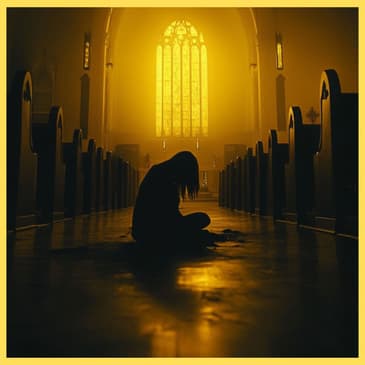
Warning: This episode contains disturbing content related to violence and death during exorcisms. Listener discretion is strongly advised.
You can get these ad-free through ScaryPlus.com free for 14 days, then 4.99 per month. Cancel anytime.
You can find Edwin on TikTok, Facebook, and Instagram as @edwincov
Get in touch HorrorStory.com
Join our community:
Facebook.com/scarypod
Instagram.com/scarypod
tiktok.com/@truescarypod
youtube.com/scarystorypodcast
The following episode includes descriptions of violence against women and children through real life cases of exorcisms. Listener discretion is strongly advised. In nineteen ninety nine, the Catholic Church made a major update. You see, they have rules about exorcisms and they hadn't been changed since sixteen fourteen. The point of it was to address an important issue, what is the difference between demonic possession and psychological or physical illness. If someone is displaying signs like what we see in the movies, like twisting, yelling out curse words, hurting others or themselves, would a preset automatically assume that they were being possessed by the devil maybe some other demonic entity by default, And if they displayed multiple personalities, was that considered grounds to perform an exorcism? That's what changed now. You must a lot causes, So they're going to work with teams of doctors, psychologists, and psychiatrists to roll out everything. After all, you might have a case such as epilepsy or schizophrenia and not something supernatural. If nothing else worked, they would begin what they call deliverance prayers, and if those don't work, then a major exorcism was next, and that would be sort of a last resort. But not everyone follows these rules, things that go from simple things like what a priest must wear, tools to use, and such, to the actual process and things to say. But in two thousand and five, a Romanian priest and four nuns were standing before a judge, receiving sentencing fourteen years in jail for the priest and the nuns receiving between five to eight years each. The reason the death of Arena Carnucci, a twenty three year old none that had died during an exorcism. That's only one of the cases I will tell you about today where exorcisms, the practice of getting devils out of a person, have turned deadly. My name is Edwin and here's a horror story. Most of what we know about the case of Arena Carnicci was documented by the former editor of the Bucharest, Romanian Bureau of the BBC, one who followed the story closely and wrote a nonfiction novel about it, ended up being called Deadly Confession. This was written in two thousand and six and then a second edition published in twenty twelve. The story was so bizarre and tragic that it was later made into a film called Beyond the Hills is based on these two books, but despite the success of these stories, the actual case was nothing to be happy about, and it starts off in a state orphanage. Two friends, Irena and Kitsa, had spent their childhood there an orphanage subjected to abuse. Once they turned eighteen, Irena decided to go to Germany, but before she leaves, she goes to visit her friend that had also been her teenage sweetheart. The thing is Kitsa as now living a religious life and worships God. In this convent, Irena can't stand the fact that she's lost Kitsa, and eventually she suffers a violent fit. Turns out Kitsa had confessed their sexual experiences in the orphanage to Father Daniel, which is, of course, in the Catholic Church, a sin. Because of this fit, they desperately try to get her some help and are finally able to get her to the hospital. Irena was sedated and diagnosed with schizophrenia, moved from place to place, but neglected by the staff. Eventually, still in two thousand and five, even though Irena is not doing well, she is discharged from the hospital because they say that she's going to get better at the convent. They take her there and she's given a booklet kind of thing, a list of a bunch of sins, and she's supposed to check mark the sins that she's committed. You see the head of the convent here, Father Daniel, is a super traditionalist priest from the Romanian Catholic Church. He performs healing sessions for pilgrims and believes that evil is all around them. But a few days go by and Arena is having trouble because, if you remember, she's trying to get to Germany, but the place where she's trying to go to, once she gets there, working with a wealthy family, it turns out someone else had taken that job. Irena then has another fit and begins to kick everything and everyone around her. But at this time there are pilgrims at the ceremonies that Father Daniel is running, so in order for no one to notice, they take Erina up to her cell and tie her to the bed Erna obviously isn't happy about this and begins hurling insults and yelling. Eventually they tie her to another stretcher that they made on the spot, one in the shape of a cross to bring her into the church, and that's where the exorcism begins. For two days, the priest and the nuns are fasting and praying for the demons to go away, the ones they believe are possessing her. She's chained to this cross. A towel is stuffed in her mouth so she stops screaming. All while she's mumbling curses and kicking. Eventually, Irena calms down and Father Daniel thinks that the job is done, but then Irena faints. They call an ambulance who finds her unconscious and gives her shots of adrenaline, but once they get her to the hospital, they found out that she's actually dead. What happens after is a series of blames. Was it the member of the church that killed her, or was it the ambulance medic. Was she alive when she got to the actual ambulance, or did she die along the way. Eventually, the manager that was in the emergency units gives out a report, one that says that Arena was dead for a few hours, even though the nuns that called in the emergencies say that Arena was still speaking that's when they called the ambulance. Still, the court spoke and made the ruling. The victim, Irina Cornici, twenty three years old, was killed during the ritual at the convent in the northeast of Romania. An article by the BBC mentioned Daniel Petru Koragino, thirty one years old, Father Daniel, the priest at the Holy Trinity Convent in Tanuuk Village, as a main guilty person. Manslaughter was a charge, fourteen years in jail was a sentence. Father Daniel was banned from priesthood. The four nuns were excommunicated, one of which Nicoletta Arcolinu got eight years in prison for while the rest Adina Sipraga Elena Hotel Simona Burdana got five years each. Sadly, though Irena would still not rest, the appeal from the accused led to Arena's body being exhumed for a second autopsy. The results were that she had died from suffocation and dehydration, Consistent to what another novice nun had said, Irena had not been given water during the ritual. This case would later become known as a Tenaku exorcism, something you may have heard of before. Many things bothered me about this case. There was a history already from a psychiatric hospital that Arena Carniccci had symptoms of skin zophrenia. This was noted by doctor Georgia Sevostrovicci, who said that Arena thought that the devil was talking to her and was telling her that she was a sinful person. This would make sense considering she was given a list a checkmark with sins that she had committed, things like falling in love with another woman. When more details came out, they came up with the truth. Irena had been gagged with a towel, left in a room at the convent for three days without food or water, bound to a cross. This was something that the priest said was necessary because she was violent and refused to drink holy water. Of course, as humans, we hold our own biases with this like for me, for example, it was once observing a ritual in the hills of Peru, a food offering to the Bacha Mama Mother Earth, when due to the heat of the middle of the day, a woman we had been talking to began to faint. Instead of taking her to the shade, offering her water or getting medical help. The group leader lit up the cigar like thing they had and started blowing smoke on her face while chanting. Thankfully, she reacted and was sat down to rest, but I was still pretty shaken up. My point is that if we're going to believe in the power of rituals and exorcisms, something that requires us to trust experts with our lives, there needs to be more than just quote medical clearance, especially if it's monitored by themselves all Catholics, as established by the Catholic Church. Of course, the nuns and the priests believe that they were helping her, which if we look at it with an open mind, could be possible. But as a person living in a human body no food, water, no air, well, we know what happens and these types of cases are not uncommon. More recently, in twenty twenty two, Claudia Hernandez Santos was arrested with assault on a child in San Jose, California. The victim was her three year old daughter. She told the police that her daughter was possessed because she would be sleeping and then wake up out of nowhere, screaming and crying. She was taken to church where they performed in exorcism along with her father. I will spare the details here, but the little girl was held down and was left unable to breathe. The entire thing took about two hours. The child's grandfather and pastor of the small Pentecostal church, as well as a child's uncle, Renee Nande Santos, were arrested. There was another case that I could not immediately find the time or location about it, but in the Journal of Forensic and Legal Medicine by Science Direct, I found another case of a nine year old child taken by her mother to an exorcist. This was to expel a demon from her body. On the second day, after being given only water to drink, she lost consciousness and then she was taken from medical attention, but she was pronounced dead. It turns out they had been giving her medicinal syrups by force and some of it had gotten into her lungs, causing aspiration pneumonia. And then in twenty twenty three, a man died of an exorcism performed on him by his family, according to a Taiwanese article. And like this, there are many more accounts of deaths by exorcism, but there was one case you may have heard of. It was from a woman in Karawa that sparked an entire movement to protect women in the Latin American country. High in the mist covered mountains of northern Nicaragua, deep within the rural committee of El Cortessal, a chilling event unfolded in twenty seventeen, an event that would horrify a nation and draw international headlines. It began, as many stories in isolated villages do, with whispers. Vilma Trujillo was a twenty five year old woman, young, quiet, and deeply religious. She lived in a small wooden home with her family, including her husband and two children. Life in El Cortresal was simple and steeped in tradition. It was a place where neighbors were lied on each other, and faith was not just part of life, but it was life. But in late February of that year, something changed. Wilma began acting strangely. According to those who knew her, she wandered off into the forest alone and returned saying things, things that frightened her family. She spoke of visions of evil, of something trying to take control of her. People said that she was no longer herself. In many places, someone in Wilma's states might have been taken to a hospital, diagnosed and treated. But Cortesale is a place far removed from cities and doctors, and so her family turned to the only authority they trusted, the church pastor Juangregorio Rocha. Romero was a spiritual leader of a small and magelical congregation. It was not a man of formal theological training, but he was deeply respected. When Wilma's relatives brought her to him, he didn't hesitate. He said it was clear Wilma was possessed by the devil. What followed can only be described as a nightmare. Cloaked in the language of faith, the pastor ordered an exorcism. For several days, Villema was held inside the church, tied up, denied food, water, subjected to repeated prayers and spiritual cleansing. According to some accounts, she was physically abused during this time, her body showing signs of restraint and injuries, but it wasn't enough. On the fourth day, Pastor Rocha told his followers that the only way to rid Vilma of the demons was by fire. He claimed the spirit within her had resisted all prayer and that the only thing that would help would be flames. So they took Vilma, frightened, exhausted, and still alive, to a ravine near the church. There they built a fire and then, in front of several witnesses, they threw her into the flames. When asked later why he did it, Pastor Rocha insists that it was not him, but the voice of God that spoke through him. He said the fire would not harm her, that it would only burn the demon, But it burned her. Vilma was pulled from the fire, still breathing. Her body was covered and burns. Over eighty percent of her skin had been seared. She was rushed to a hospital in critical condition, and for days doctors tried to save her, but the damage was too severe. Vilma died on February twenty eighth, twenty seventeen. Her death sparked national outrage in Karawa. Protests erupted and human rights groups demanded justice. How, they asked, could something like this happen in the twenty first century? How could a woman be burned alive under the belief that she was possessed? Pastor Drocha and four of his followers were arrested and later convince for Villema's murder. The trial revealed horrifying details how the group believed so deeply in their spiritual mission that they ignored her screams, her pain, and her humanity. For many, Villema's death exposed the dark undercurrent in parts of Nicaragua, the dangerous intersection of religious fanaticism, poverty and isolation, and communities without access to proper health care, mental health support, or education. Superstition can become deadly. But at the heart of it all was a woman, a mother, a daughter, someone whose life had ended not because of evil, but because of those around her believed in it too much. Vilmatruhillo became a symbol, a cautionary tale of what can happen when blind faith replaces compassion. Though her voice was silenced, her story continues to echo across Nicaraiwa, a tragic reminder that belief, when twisted, can become a weapon. Joanna Lee born kilm Oak Lee was a South Korean woman in her late thirties, carrying with her a life marked by trauma. Daughter of divorced parents, she had battle depression, attempted suicide more than once, and lived with vitoligo, a condition that made her skin change color in patches, something that reportedly contributed to her emotional struggles. In nineteen ninety nine, she met a man named Luke Lee, a self declared pastor with a criminal past. He had served prison time in South Korea for fraud and dodging military service, and yet somehow he entered New Zealand on a student visa and began building a following. He founded a small religious group he called Lord of All in Auckland Part It's been a costal part cult like and deeply secretive. Joanna identified with Luke Lee's message, his charisma, his conviction, and his promises of healing seemed like answers she had long been searching for, and by October two thousand, she left her life in South Korea and traveled to New Zealand on a three month visitor permit. She moved in with a pastor and became immersed in his church and the community. By early December, pastor ly announced to his congregation that Joanna was possessed by demons, at least twenty of them, he claimed, and to free her she needed deliverance, and what followed would be called in exorcism by those inside of the church. Others would later call it torture. On the night of December eighth, the ritual began in the church hall. It continued the following day in Pastor Ly's rented home in Mount Roscoe. Witnesses described a six hour ordeal. Joanna screamed, cried, thrashed, and Pastor Lee sat on her chest. He balanced on her body, he struck. Her bones were broken and bruises spread. Finally, she was strangled and she stopped breathing, and yet no one called for help. Instead, Pastor Lee told this congregation that she would rise again, that she would resurrect, and so they waited. They recorded her lifeless body on video. They tried to clean her corpse with alcohol to suppress a stench of decay, but after nearly a week, someone on the outside grew suspicious and alerted the authorities. When police arrived on December fifteenth, they found Joanna Lee's body decomposing in the home. Pastor Luke Lee was arrested in charge with manslaughter. At trial, Lee represented himself, but he barely participated. When he did speak, it was to say something strange like Joanna will rise from the dead. His court room performance must have been bizarre to witness. In two thousand one, he was convicted and sentenced to six years in prison, but a story wouldn't end there. By two thousand five, while appealing the conviction, he was deported back to South Korea, and then in two thousand and six the New Zealand Court of Appeal overturned the ruling. They argued that Joanna may have consented to the exorcism, and that this possibility hadn't been adequately addressed in court. Every trial was ordered, but by then Pastorly and most of the witnesses were gone. Authorities issued a warrant for his arrest should he ever return to New Zealand, but he never did. To day, the house on Mount Roswell stands quiet. Most people have forgotten the name Joanna Lee, but her story lives on in whispers. A desperate woman, a dangerous pasture, and a fatal ritual in the name of salvation. Del Gooda, a town nestled about forty kilometers from Colombo in Sri Lanka, is a place where ancient beliefs intertwined with daily life. Among its residents was a woman who was known for her ability to expel demons, a self styled exorcist whose methods were as feared as they were sought after her local mother grew convinced that her nine year old daughter was possessed by a demon, and in her desperation, she turned to this exorcist, hoping to free her child from the unseen forces she believed were at play. The ritual was brutal. Oil was poured onto the young girl's forehead, a traditional preparation for the ceremony, and then the exorcists began to beat her with a cane, striking repeatedly in an attempt to drive out the supposed demon. The child's cries echoed through the neighborhood, prompting concerned neighbors to intervene, but despite their efforts, they couldn't stop the ritual's deadly progression. The girl lost consciousness and was rushed at the hospital, where she was later pronounced dead. The authority swiftly arrested both the mother and the exorcist, and they appeared in court facing charges that underscored the tragic consequences of deeply held superstitions. Police issued warnings about the dangers of such rituals, noting that this is the first time an exorcism had resulted in injury or death in the area. This incident forced Algoda to confront the perils of unchecked beliefs and the practices they engender. It served as a grim room reminder of the need of awareness and education to prevent such tragedies in the future, and again cases like these continue. In October of two thousand and seven, in Wellington, New Zealand, twenty two year old Janet Moses tragically drowned during a family conducted exorcism. It was a ritual intended to lift a Morrowi curse or a makutu. It was believed that it was afflicted due to a relative's theft of a sacred artifact Taunga. Approximately forty family members gathered, using large quantities of water in an attempt to cleanse her. The ceremony turned fatal as Janets was held under water, leading to her death. Authorities treated the incident as a homicide, highlighting the dangers of such intense spiritual practices. My intention for this story I was telling you about now initially was to just share with you how cult like following can turn deadly, but very quickly, I was thrown into religious and cultural ideas that are near impossible to argue with. They're just too massive, they have a large following. Who is to say that there isn't power of belief to cast out devils? Though? But then again, what if there are just mental and psychological issues that must be dealt with using the tools we have available. It's up to us to make our own decisions as to what we choose to believe. But the more I read up on this, the more I realize what a slippery slope our mind can be when we start believing something that gets reinforced by others. Losing control of our minds is a real horror. How can we firmly believe that we are doing something good when quite literally, we might be making a fatal mistake. This episode of Horror Story was written and produced by me Edwin Kowarubyas. I've been receiving cases and places to research through email and DM so we have a lot of work to do over here, which I'm thankful for. I'm also looking for new cases I can talk about in my new podcast called Paranormal Club. You can find Paranormal Club by searching for it right now on your app. Links to everything, including how to get in touch and how to support the show, are in the description of this episode. If you are following this podcast, I will tell you another story next week. Thank you very much for listening, but scary everyone so soon.