
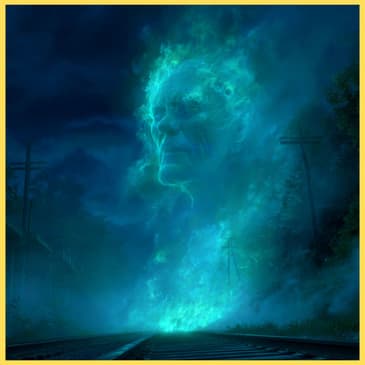
What began as a ghost story passed down through generations slowly revealed a hidden chapter of American history involving immigrant laborers, fear-driven violence, and a truth deliberately buried. This episode explores how folklore, science, and persistence converged to give voice to the forgotten dead and asks whether the spirits were ever really silent.
You can find Edwin social media as @edwincov
Have an idea you want to send? Send me an email or DM! hello@horrorstory.com
You can get these ad-free through ScaryPlus.com free for 14 days, then 4.99 per month. Cancel anytime.
Get in touch on HorrorStory.com
It was a hot and foggy night in September. A man was taking a short cut through the railroad tracks making his way back home from the Green Tree Inn in Pennsylvania. The area he was in was known as Duffy's Fill, named in part because of a railroad contractor's name and how they had to fill the certain area of land to put in. This railroad track where the hills were grubbed away was called Duffy's Cut. So he was walking down the tracks when it came upon this rock formation that he was familiar with. It was there when he saw a strange blue and green fire in the shape of ghosts. They were hopping and bobbing around in the dirt. The ghosts, he said, were of the irishmen that had died from cholera a month before, all dancing around the big trench where they were buried. There was a grave of a small group of unfortunate men who had died due to the illness. Needless to say, he was scared, and in his own words he said, there I stood, knocking my knees together, and ghosts advancing and groaning all the time. At last I fell down. I don't know how long I lay there. When I came to the ghosts, we're all gone. He ran back to the road that led to the pike and got home that way, never to take that same shortcut back home again. But what did that man see that night? Because over one hundred and fifty years later, in that same area, a couple of men would also witness strange neon light formations in there, but this time, by pure chance, it will leave them to uncover a story of prejudice, murder, and a debt that was long overdue. But were the dead making themselves known in order for us to know their story? Because I think so, and after hearing about what happened, you might start to think so too. My name is Edwin, and here is a horror story. So it was nineteen thirty two when the encounter had happened, and the old man was able to tell his story to a writer for the Pennsylvania Railroad Company back in nineteen oh nine, memorializing it for everyone in the article. The writer tries to tell the man that, hey, maybe what you saw were ignes fatus, a strange light that might have been caused by so many of the cholera victims being buried together. The old man wouldn't budge what he had seen were ghosts bobbing up and down and making their way toward him on that warm, murky night in September. The old man, of course, knew at the time that the outbreak had happened just weeks before. When he said that they had died from cholera. That's what he was told. But as we'll find out, he was wrong. I mean, they may have had cholera, but it wasn't their cause of death, and their spirits were desperately trying to tell well, show the researchers another story for over one hundred and seventy years. So our story really begins in the eighteen thirties, when poverty and religious prejudice under British rule was driving thousands of young irishmen away from their homes in search of a better life. For a certain group of laborers that were coming from Ireland, this promise of a new life would be just across the Atlantic Ocean. So in the spring of eighteen thirty two, they boarded the John Stamp, a three masted ship bound for Philadelphia, and when they arrived on June twenty third, after a long and tiring two month voyage. They were desperate to make their efforts be worth it, just like many immigrant journeys, a chance to work, to earn and to build a better life in a new world. And there really was work in the new world. In fact, men were often hired right off the docks. It was like that with this Irish born contractor named Philip Duffy, who was working on one of the most ambitious engineering projects of the era, the Philadelphia and Columbia Railroad. So he was looking for workers. And when I say this task was massive, I mean it was colossal. It was herculean, is what they were calling it. Their assignment was mile fifty nine, a notoriously difficult stretch of track near Malvern, Pennsylvania. It would become known as Duffy's Cut. Now it's hot over there, And it was in the summer of August eighteen thirty two when the brutal task was assigned to level a hill and use the excavated earth to fill Another part of it was creating this level bed for a horse drawn railroad. To get an idea, it must have felt like getting rid of a mountain to fill a valley, except on a smaller scale, but still it was the biggest industrial endeavor in Pennsylvania at the time, and Philip Duffy was not going to turn it down. He was known for exploiting people that came from his country, putting them in these crowded places and paying them as little as he could so that he could get more for himself. Fifty cents a day is what I found in a large allowance for whiskey. It would be working with pickaxes and spades through that sticky and heavy clay to fill that ravine that was fifty to eighty feet deep. But that summer heat would also bring something more dangerous and deadly than the work that was assigned to them, a global pandemic, an invisible enemy that would be blamed for their deaths. Although the truth was going to be hidden for decades. From historical records, we know that in the summer of eighteen thirty two, the second global color of pandemic reached Philadelphia. The disease spread through contaminated water, was terrifying and poor understood. Doctors believed it was caused by bad air when everyone panicked. Now, this fear was made even worse by deep seated racism and prejudice. Irish Catholic immigrants were already viewed with suspicion because that part of the United States at the time was Protestant, and the cholera outbreak added a deadly new dimension. Now check out this quote. Irish Catholics were understood in Protestant America to be the agents of the infection of popery. Men's aversion when they were also perceived to be the agents of infection with cholera. Any result is imaginable. Now when you think of a certain population is a cause of your pains, like it says, any result is imaginable, people are willing to do the worst things to them. In this case, there was no exception. When cholera struck the workers shand at Duffy's Cut in mid August, the surrounding community reacted just as you would expect, with fear violence. The sick men were shunned, abandoned, and effectively imprisoned in the valley. Secret railroad records state that the men who tried to flee were forced back to the camp if they needed help. If they tried to escape, no one was going to help them. Now, with some very honorable and courageous exceptions, though, because local residents close their houses refused to give them food or housing, stagecoach drivers simply avoided the infected site, and when workers try to get life saving help, they were sent off to die in the valley. It was a result of chaos and panic that, though logical, still lacked what makes us human, doesn't it. But like I said, there were a few exceptions. The blacksmith named Malachi Harris stayed behind to take care of the sick, and when it was finally required by himself, started digging graves for the dead. Four sisters of charity also walked from the nearest town to help the dying men, despite them being forced to walk back to Philadelphia in the blazing heat. After that, once everyone had died, the blacksmith remained to perform the grim and only task of burning the shanty and everything that was inside. In the immediate aftermath, the true scale of the tragedy was deliberately kept secret. Local newspapers reported only eight or nine debts. However, internal railroad records later confirmed that fifty seven laborers had died. The contractor, Philip Duffy, resumed work with a new crew completed the project and died a wealthy man in eighteen seventy one. His legacy is a mansion that still stands at fortieth and Pine Street in West Philadelphia. But the legacy of his fifty seven countrymen was a mass grave dug very quickly in the Valley phil that one that they had died creating. But despite the official silence, the memory of the dead was kept alive through folklore and small defiant acts like the picket fence a railroad worker erected in eighteen seventy the one to mark the forgotten grave. But remember, the story was also buried, and it would be the ghost stories that would survive and eventually lead to the discovery of the truth. For over a century, the full story remained buried. Now let's fast forward to two thousand and two. Twin brothers Bill and Frank Watson were sorting through the belongings of their late grandfather, Joseph Tripschan. Now Joseph had been the executive assistant to Martin Clement, a former president of the Pennsylvania Railroad, and among his stuff was PRR File zero zero four dot zero one. See it was concerning Duffy's cut. The file which Martin Clement had told people to keep secret, contained the railroad's own nineteen o nine investigation, the same one that confirmed fifty seven deaths and providing clues to the grave's location. But to the twins this was something more, because every year during Thanksgiving, their grandfather Joseph would tell them a ghost story, one about ghosts that appeared near the woods in a suburb of Philadelphia, Pennsylvania, late at night. He would say, you can see a large group of Irish immigrants glowing brightly and dancing on their graves in an area called Duffy's Cut. Of course, all the way up until their grandfather died, they thought that it had just been an urban legend of sorts. But there right in front of them, this time with PRR file zero zero four dot zero one c it was a true story. They also found the story that I told you about in the beginning, about the man who was walking back from a tavern and passed out from fear after seeing a bunch of green and blue fire like ghosts that are slowly moving toward him. Now, it's worth noting here that separate reports have completely different dates and when this incident happened. Some of them say nineteen oh nine, others say some nineteen nineteen dates like that, but from the scan of the original document, considering that the man in the story had mentioned the pandemic that had killed many people several weeks before, he was actually referring to September of nineteen thirty two. In case you go out and read about it and find the discrepancies that I did. But either way, they're about to uncover that one of the legends that their grandfather told him was real. But still there was something lingering of one of their minds, specifically Bill Watson, one of the two brothers, because he he may have had an encounter with the spirits. It was an event that he tried to eventually forget. It was around ten in the evening after a performance when Bill and a fellow piper, Thomas Connor, were at the Immaculata office to use a bathroom. Now, something interesting about the brothers is that they are bagpipers, so they do performances in their spare time, sometimes on Penn's campus. Bill is an academic historian as a professor of history at Immaculata University near Malvern, Pennsylvania. Well, like I, said they had gone to use a bathroom and it was there that through a rectangular window that was facing south. Thomas Tom, how they refer to him, was like, Billy, what am I looking at? Now? That's a funny question to ask, well at a YearIn all, but anyway, Billy asked him what he meant. That's when Tom explained that he was seeing strange neon like figures standing completely still. Bill looked through the window and saw, from what he wrote in his book, three illuminated figures standing perfectly still facing them, and they looked like thin human forms with legs stretched out in a v and arms pointing to the side. Their heads looked like they were only addendums to the torsos. They were completely illuminated in the dark field outside the bathroom. And then he ends with and my nearest approximation was that they were neon lights. So though they were standing looking out, not freaking out or anything, until they suddenly vanished. That's when they left the bathroom as quickly as possible. They went outside and looked around, but there was absolutely nothing there. Billy asked around the next day if any of his colleagues had heard any stories about what it could have been, but there were no sort of light show or anything the night before, and as a chair of the history department, he didn't want to ruin his reputation and instead just dropped the subject. That was until that labor day the weekend in two thousand and two, when he and some of his family members were looking through some of the files that belonged to his grandfather. As soon as he saw it, he realized it was a hidden history connected to the very area where he had gotten a job. He called up Tom, his bagpiping friend from that night, and said, Tom, I think I may have an explanation for what we saw that night. Now, that file zero zero one dot zero one c called history of Duffy's cut Stone Enclosure east of Malvern, Pennsylvania, which marks the burial of place of fifty seven track laborers who were the victims of the cholera pandemic of eighteen thirty two, said a different truth than what the newspapers had sat at the time. It was not eight or nine deaths. It was way off. Now, why does his file exist if it was supposed to be kept secrets, right, especially from such a large company like the Pennsylvania railroad. Well, bill has some answers for this. It dizzy to get tangled up on it, so let me try my best year. The deaths happened in nineteen thirty two, but in nineteen oh nine Martin Clement, an assistant supervisor for the railroad at the time, started investigating. Now, Martin was living in Malverne with an Irish family, the Dono Hues, and it turns out that the wife, Bridget Doyle, who was a sister of Patrick Doyle, a railroad worker who had put a wooden fence around the burial site in eighteen seventy, word had spread it around the railroad workers after all, so Martin learned about the story and he wanted to replace the rotten wooden fence with a permanent store enclosure along with a bronze plaque that said that fifty seven men had died at that location during the construction. Due to the color of pandemic, it was able to build a square shaped stone enclosure to the mark the site, built out of old granite blocks that had supported the original eighteen thirty two railroad tracks, But the railroad did not want to ruin the reputation and said that it was too expensive to make a plaque and it was forgotten. They marked the file as secret and to not leave the office. Martin Clement eventually became president, and it was him who showed the file to Bill's grandfather, Joseph, and told him, this is what happened here, but you're not to tell anybody. And when the Penn Central Railroad went bankrupt in nineteen seventy, Joseph removed a file from the company's vaults so that it wouldn't get destroyed. Now, isn't that cool? It became a story of a story and how it was kept alive because high ranking officials valued history, even if they couldn't share it publicly. So back in two thousand and two and the discovery of the files right, the brothers assembled a team of historians and volunteers, forming the Duffy's Cup Project. Their work began with research, carefully transforming local legends into a formal investigation. They first located the stone wall that Martin Clement had built and forgotten monuments made from stones that supported the original tracts. Like I mentioned earlier, they searched through historical archives verifying the contents of the secret file and also found accounts of the cholera outbreak and anti immigrant sentiment. In two thousand and four, the work led to the installation of an official Pennsylvania State Historical marker, publicly recognizing the mass grave for the first time. At the site of the original shanty, they began to unearth artifacts that painted a picture of workers' lives, buttons, pottery, cooking utensils, and clay pipes stamped with the word and then in November of two thousand and five, they found it. The bowl of a clay pipe adorned with shamrocks and a small harp. Bill Watson would later call it the Holy Grail, tangible proof connecting this piece of Pennsylvania soil to the men from Ireland. After years of searching, the team had found artifacts, but no human remains. The breakthrough came when they enlisted geophysicist Tim Bechtel, who brought ground penetrating radar GPR to the site. By shooting electrical currents through the steep railroad embankment, Tim created a map of what lay beneath the surface. His GPR equipment detected several large anomalies. These areas where the ground was electrically resistant He theorized that these were air pockets left behind by decomposed bodies. Science had finally pointed the way to the exact location of the graves. Now, with science pointing the way, it was only a matter of time before their shovels struck the very bones that had haunted the valley for nearly two centuries, and the stories they would tell was not what they were expecting. So now it's March two thousand and nine, just days after Saint Patrick's Day, and the diggers noticed something different, weird colored soil and like anything else had seen, and they found coffin nails. A volunteer shovel finally struck a human tibia. The team had found, for the first time, one of the lost workers. The remains were sent to doctor Janet Monge, a forensic anthropologist at the University of Pennsylvania Museum, for analysis, and as she examined the skulls, she made a stunning announcement that shattered the official story. She said, if they had cholera, it didn't kill them, I would say something else killed them. Now, the doctor's analysis revealed that several of the men had not died of disease, but of violence. The skeleton showed clear signs of perimortem trauma, injuries inflicted at or around the time of death. The bones told the story of a brutal attack, not a natural epidemic. Multiple skulls showed divots of fractures, indicating the victims had been clunked on the head. One skull displayed a thin, long trauma, consistent with the blow from an axe. Another skull had a perforation that looked very much like a bullet hole, and a magnet analysis later confirmed the presence of metal in the skull. The forensic evidence gave rise to a new horrifying theory. The men of Duffy's Cut were not only victims of cholera, if were victims of a violent massacre. The researchers hypothesized that when the disease struck, local vigilantes, driven by anti immigrant prejudice and fear, murdered the sick irishman to enforce a quarantine and prevent them from fleeing the valley. What had been presented as a public health tragedy was in fact by human rights to atrocity. The story of murder and one hundred and seventy year old cover up, the project's focus shifted from forensics to identification. Story of the first skeleton that they found demonstrates to the remarkable combination of science and historical detective work that allowed the team to give one victim his name. Back analysis showed that the remains belonged to a muscular young man about eighteen years old, who stood roughly five foot six. The skeleton was congenitally missing an upper right for smoler, a genetic trait that a forensic dentist called exceptionally rare. Eventually, the linkedum as a passenger, the one on the list of the John Stamp the ship, the one that was arriving from Ireland that spring with a large group of laborers. It was there that they listed an eighteen year old named John Ruddy from County Denegal. The Watson brothers contacted Ruddy families in Donegal and astonishingly, they found a family with the exact same rare dental defect. The evidence was overwhelming, so in February of twenty thirteen, the remains of John Ruddy were carefully boxed and flown back to Ireland in a church cemetery in the small town of Dara Donegal one hundred and eighty one years after he left seeking a new life, John was finally given a proper burial and laid to rest in his native soil. In twenty fifteen. The remains of Catherine Burns, a woman believed to have been a cook or a person who washed the clothes for the crew, were also identified and returned home for reinterment. These acts fulfilled the core goal of the project to restore the dignity and the identity of the forgotten. The return of John Ruddy and Catherine Burns was a victory, but it was just one part of repaying the debt to all fifty seven souls that were lost at Duffy's Cut. Before any individuals could be identified and sent home, the first duty of the Duffy's Cut project was to provide a proper Christian burial for the unclaimed remains, and on March ninth, twenty twelve, the remains of five of the workers, four men and one woman, were formerly reinterred at West Laurel Hill Cemetery just outside Philadelphia, that were lated to rest beneath a large Celtic cross that were honored with the ceremony attended by American and Irish dignitaries, finally receiving the respect that they had been denied. In eighteen thirty two, the Duffy's Cut project became an act of historical justice. He has unearthed the story of immigration, exploitation, and deadly prejudice. By combining folklore, forensic science, and tireless research. A small group of dedicated people gave names to the nameless and a voice to the silence. Their work serves as a powerful reminder of the human cost of building a nation and forces us to ask timeless questions about our shared humanity. To close, I'll leave you with a reflection from Frank Watson on how the story TRENDSNDS history. How do we treat our employees? How do we treat people who immigrate for a new life? Every human being deserves to be remembered. I first stumbled upon this story from an old CNN article. Actually it was another type of agency that was talking about this stuff. But the original article came from an old CNN port and it was called something about how a ghost story led to solving one hundred and eighty nine year old mystery or similar title. And upon researching that is when I started finding out all this information. There's been other people have documented this story, but I also found I think one of the better jobs was done by Astonishing Legends by Scott and Forrest who do their awesome podcast. They had an actual interview with the brothers and they have the actual scan of the document there on their website, So go check it out in case you're interested to find out more about this story and dive a little bit deeper. You can find their podcast it's called Astonishing Legends and let me know what you think of it. Also, this story, as I was researching it, I couldn't stop myself here and connect the dots about how we're talking about chasing dreams and not losing our humanity. You know, these were immigrants. They came from Ireland, and the Irish were not viewed in the way that they were viewed now, you know, because the United States at the time was a completely different thing like it was. You know, religion was a very strong driver in a lot of people's actions and the mix of cultures wasn't clearly established yet, and yet they needed immigrants to help move the nation forward. So you know, it became a thing of like well, they're coming from there. The infected ones, they kind of, you know, get rid of them a little bit easier because they thought of them as a little bit less. So things to think about, you know, especially nowadays when we have kind of a similar sentiment with immigrants and other thoughts. But anyway, Bill and Frank seriously thank you for the work that you do. Great work with the project. You want to help them out, you can just quick Google search will take you to the Duffy's Cut project and what they've they've done so far and what they're doing so just a great, very great movement. I guess that's been started with it. It'd be awesome to check them out, maybe drop them a note about you know, how you heard of their story and everything. But after all, there's this lingering question that I want your opinion on. Is it possible for spirits to return, for us to share their untold stories? Was all this really coincidence? Let me know what you think. If you're listening on Spotify, you have a spot there for dropping comments. You can also reach out to me directly. If you're listening on app a podcast or another podcast player, just dm me on Instagram TikTok or Facebook Edwin Cove THAT'SNCOV. And also we have kind of a discussion thing on our other podcast, Paranormal Club. So Paranormal Club is the name of it. You can find it on YouTube and Spotify in video and everywhere else in audio. Horror Story is produced and written by me Edwinko Barrubiaz and if you have any questions or anything, please let me know. Also, thanks a lot for sticking around Horror Story. I just want to tell you how much I appreciate these listens because I took some episodes off, like I said, sometime off from the podcast, a close friend of mine, my best friend passed away recently and a bunch of us got together that was travel involved, and we're just dealing with what comes after that and all those thoughts and how we view death and everything. So I appreciate you sticking around. I mentioned this in some of the other podcasts as well, but we should be getting back to regular schedule as of like right now. Anyway, I appreciate you being here. Thank you so much for listening. Keep it scary everyone, See you soon.