
You can find Edwin social media as @edwincov
Have an idea you want to send? Send me an email or DM! hello@horrorstory.com
Voicemails: fanlist.com/scary
You can get these ad-free through ScaryPlus.com free for 14 days, then 4.99 per month. Cancel anytime.
Get in touch on HorrorStory.com
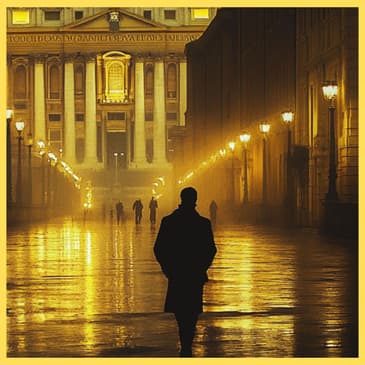
They say the devil hides in plain sight, But for one man within the walls of the Vatican, evil wasn't a way to describe darkness. It was a face with a voice when that hissed and spat and screamed in languages that didn't exist anymore. The presence that would crack bones and levitate bodies, also darkening rooms with an unseen power. I'm talking about Father Gabriele Amort, who wasn't just a priest of soft words or rituals as you might know them. He was the Vatican's chief exorcist, a man who claimed to have battle demons tens of thousands of times. He described the devil as cunning, patient, and absolutely real, a presence that knew your secrets, preyed on your fears, never knocked before entering. Father Amort didn't ask you to believe him. He simply told you what he had seen and what he had fought. By the time he passed away in twenty sixteen, he had performed more exorcisms than any other priests and recorded history over seventy thousand by his own account, although many of those were just blessing. It's not exactly a full on exorcism, But it was the true possessions, the rare, the chilling cases where something seemed to take hold, the ones that haunted him and also fascinated the world. It's the same reason why you're here. He kept meticulous records and wrote books, and he also gave interviews, But many of his most disturbing stories were told in the kind of a whisper that you hear in a deathbed confession. Because what Father Amoa has faced wasn't just as supernatural. It was the deep personal suffering of people caught in the crossfire right between ancient faith and modern doubt. Does this actually exist? This episode, I'll tell you the story of the Church's last great exorcist, of a man who claimed the devil knew him by name, and of the battles he fought alone in silence and with nothing but prayer, holy water, and unshakable faith. My name is Edwin, and here's a horror story. In order to understand the darkness he faced, we must first understand the man who chose to walk into it. Before he became the Vatican's most famous demon fighter. Gabriele a Mort was just a boy from Moina, a city in the northern plains of Italy. Born on May first in nineteen twenty five, his early life gave little indication of the future that awaited him. In fact, his first fight wasn't against demons at all. It was against fascism. During World War II, Amore joined the Italian Resistance, risking his life in defiance of Mussolini's regime. He was barely out of his teenage years when he picked up arms for justice. It was a taste of war that would leave its mark, because in chaos he found conviction, and in human darkness, perhaps a glimpse of something deeper. After the war, he studied law and wrote for Catholic journals. He was intelligent, articulate, and devout, but still no one expected him to become the church's most public faith in the fight against evil. He didn't even enter the priesthood until he was nearly thirty, a late start by clerical standards. In nineteen fifty four he was ordained, and for years he served quietly as a parish priest. Then in nineteen eighty six something changed. He was appointed assistant to Father Candido Amantini, the chief exorcist in Rome, an intense, reclusive man who had carried the church's most secretive and controversial right for over three decades. Under Amantini's mentorship, a Morth began to witness things that to fight everything he thought he understood about suffering, psychology, and faith. He watched bodies twist unnaturally. He heard voices emerge from mouths that didn't belong to them, guttural, growling, venomous. He saw eyes roll back and smiles that were not human. They were real events, real people, and whatever force animated them he believed it came from something demonic. When Father Amantini died in nineteen ninety two, Father a mort stebbed into his role. In interviews, he often said he had never sought this path. You do not choose to become an extorcist, he once said, it chooses you. And from then on he became the face of modern exorcism in the Catholic Church. Outspoken, controversial, relentless. He gave lectures, wrote books, and trained new exorcists, but he also did a lot of listening every day mothers with possessed children, husbands whose wife screamed in Latin at night, young people tormented by suicidal thoughts, and invisible clause. They would all come to him, and not every case was possession. He was the first to admit that most were psychological, he said, depression, schizophrenia, trauma. But a few, a very few, were different. They had no medical explanation. And when he stood before those people Bible in hand, something ancient stared back through their eyes. And so began the second war of Father gabrielea Mort's life. This time he would fight with nothing but crucifixes, prayers, and pure spiritual power. She arrived wrapped in silence, escorted by her parents and a local priests who looked more haunted than she did. Her name was Anna, pseudonym, of course, used by Father Amore to protect her identity. She was in her early twenties, pale, withdrawn eyes that wouldn't look at you. There was something that made even the most skeptical room grow still when she entered, A pressure in the air, a sense of unease that you couldn't quite figure out. Father a Mort had seen hundreds like her, thousands in fact, but something about Anna was different, and he felt this immediately. The first session began, like many others, a simple prayer, a lit candle, holy water. His first order of business was to see if the symptoms were mental, maybe emotional, or something more. But when the holy water touched her skin and a flinched, but not like someone startled. It was deeper, instinctive, as if something buried inside her recoiled, and then came the Latin the prayers of deliverance, ancient words of command, and that's when it began. Her body tightened up, her breathing changed, her eyes rolled back, and then a voice that was not hers erupted from her throat. It was coarse and mocking, and male, I've been here a long time, It said, you're too late. The temperature in the room dropped. It always did. He would later recall he had read about these cases in scripture, but in front of him it was not theory. It was possession. Over the next several months, Father and Moore would perform seventeen full exorcisms on Anna. Some sessions lasted over an hour, others stretched into the night, but one, the longest, lasted nearly twenty seven hours without pause. It really pushed the human body and spirits to its limit during these sessions and exhibited traits no doctor could explain. She spoke languages. She had never studied ancient Aramaic, Greek, even fragments of Hebrew. Her voice would shift without warning, from high pitched laughter to deep, growling curses. Objects in the room vibrated or fell, a crucifix shattered, and once in a moment that chilled the attending clergy to their core, she levitated from the floor for several seconds before collapsing. Medical evaluations were inconclusive. Neurologists found nothing, Psychiatrists were baffled. Her mriyes were clean, her lab work would come back normal. There was no physical reason for her to behave this way. Father and mort always insisted on ruling out natural causes first. It was part of its discipline. But with Anna, no cause could be found, only symptoms that defied every explanation except one. What disturbed him most was the voice that would taunt him, call him by name, and mention details of his past, and also recount his failures. She is mine, it would say, and you can't take her. Despite his best efforts, and his liberation never came under his watch. The final exorcism left her exhausted and semi conscious, but still afflicted the spirits or spirits remained. It was a rare failure for Father a Mort, and one that haunted him in later years. He would mention her again, quietly and respectfully. Some battles, he said, are longer than one life. After his death, it was reported that another priest, his successor, continued her treatment. Anna's case was never made public by the church. There were no press releases, no statements to silence and the memory of a woman who became a battlefield. It was this case that convinced Father of Mort that some possessions aren't singular. They are layered, nested like parasites in the soul, and in rare cases, no single exorcists can get rid of them. Some stories, he said, have no clean ending, just a quiet resistence of evil and the resolve to keep fighting it day after day, soul by soul. And I reminded him always that even for an exorcist, there are limits, and beyond those limits, well nobody knows. The Vatican is often imagined as a place of serene, ritual and guarded holiness, marble columns, hushed voices, incense rising like prayer. But on a bright spring morning in the year two thousand, something broke that stillness, something that tore through the calm like a scream in a cathedral. It happened in Saint Peter's Square during a general audience with Pope John Paul the Second. Thousands were gathered, pilgrims, tourists, faithful skeptics. All were waiting for a glimpse of the Holy Father. Among them stood a nineteen year old woman, flanked by family. Her name has never been released. We know only fragments here that she had been afflicted since the age of twelve, that she had traveled a long way to be there, and that the presence of the Pope awakened something terrible inside her. As a pontiff began to address the crowd, the woman collapsed, screaming not words but deep animal sounds. Her body convulsed, and her voice turned guttural. Witnesses claimed it echoed unnaturally, far louder than her frame could have allowed. Some thought she was ill, others stepped back in fear. It wasn't until she began shouting in perfect Latin, accusing the Pope of her torment and shrieking ancient blasphemies that those near her began to suspect that this wasn't a seizure or a psychotic break. This was something else. Swiss guards moved quickly, ushering her and her companions out of the square, But the story didn't end there. Hind closed doors inside Vatican walls, she was brought to a small room near the sacristy, and there Father Gabriela Morte was summoned. He arrived, as he always did, without fanfare, carrying only his worn ritual book, a flask of holy water, the crucifix, and the unwavering certainty of purpose. He had seen episodes like this before, but this time, happening right there with so many people, felt different. The exorcism began almost immediately. According to Father a mort the demon or demons inside her had reacted specifically to the Pope's presence. They hate him, he said. Later, the closer she came to holiness, more violently the demons responded. He believed the crowd's prayers, the Pontiff's blessings, and the sacred atmosphere had disturbed whatever darkness clung to her soul. During the rite, the girl reportedly attempted to bite those present. She spat, cursed, thrashed against restraints. Her eyes rolled back until only the whites were visible. Her limbs grew rigid and contorted. In a moment that chilled even the experienced exorcist. She spoke in multiple voices at once, each coming from her throat, some male, some childlike, and some whispering. Others were screaming. But it was one phrase repeated over and over that struck Father Amore to the hardest. He cannot have her. She is ours hours hours. The exorcism lasted over two hours, and by the end she lay still, sweating, exhausted and calm. Her voice returned to normal, her breathing slowed, and she wept. Father and mort never confirmed whether the possession had ended entirely. He was careful with his words. Always, relief is not the same as liberation, he once said. In some cases, demons retreat not in defeat, but in strategy. They wait, and then they return. Now, what makes this case so unique is the confirmation for multiple witnesses inside the Vatican that something deeply unexplainable had occurred. Even the church officials, who often avoided sensationalism, acknowledge the event privately. Anonymous source later told the Italian media it was real. I was there. We don't talk about it, but it happened. Father and Mort would later refer to it in interviews, but never in detail. He knew the line between belief and spectacle was thin, and that the Vatican above all feared scandals, but when pressed he would only say this, The devil does not fear buildings. He does not fear marble or tradition, but he fears holiness, and when he feels it near, he screams. That morning in Saint Peter's Square, the scream was heard by thousands. Most of them forgot him by lunch with those on the inside. The few never did. By twenty sixteen, Father GABRIELEA Mort was ninety one years old and still performing exorcisms. Hisself, though was in decline. That year, something unpresident had happened. William Friedkin, the director of the Exorcists, the nineteen seventy three film that terrified generations, contacted Father Amort with an unusual request. He wanted to witness a real exorcism, and to his surprise, Father a Mort agreed, No dramatics, no special lighting, just a real case, a real priest, and a real struggle against what he called the enemy. Friedkin was granted rare permission to observe in film one of Father of Mort's sessions, a case involving a woman in her forties named Christina, although she's referred to as Rosa and some versions of the account, she believed that she was possessed, and remort believed her too. The setting was a modest room in a residential building in Rome, plain walls, a simple chair, a small group in attendance, Rosa's relatives, a few assistants, and the director holding a small handheld camera. What unfolded next was not Hollywood. It was worse. As Father Remorte began the ritual, the Right of Exorcism, read in Latin with position and force, Rosa began to shift. Her body tensed, her eyes rolled back, her face contorted in unnatural ways, as if something behind it was struggling to come forward. And then her voice changed. It was no longer Rosa. I am Satan, it growled, I am legion. She thrashed against her seat, and at one point five grown men held her down, and still her strength surged beyond explaining. Her voice, now gravelly and masculine, taunted Father of Mort, threatening him, cursing God, mocking the prayers, She spoke languages she didn't know. Her pupils dilated fully, and she spat at the crucifix. There were no special effects, no edits, just the cold, steady unraveling of a human being before the camera lens, and the quiet, commanding voice of Father of Mors, calm, persistent and unmoved. You are clean, you are filth. Leave this, servants of God, the entity responded in chilling tones, she belongs to me. For thirty minutes, the struggle continued, drossah, convulsing, shrieking, roaring with inhuman ferocity. At one point, her body lifted slightly from the chair, arching as if suspended by invisible threads. Priedian, a lifelong skeptic, later said he had never witnessed anything like it. After the session ended, Jossa collapsed, breathing hard, soaked in sweat ice, Fluttering back to awareness, She didn't remember what had happened. Her voice returned to normal. Her family wept. Father Mort was not satisfied. He explained that exorcism, contrary to a popular belief, was rarely a one time fix. It was a process, like peeling layers of a corrupted soul one at a time. Sometimes it took months, sometimes years, and sometimes the demon resisted until the very end. Freakin took the footage to a leading psychiatrist and neurologist in the US. Some just refused to watch him, though others were disturbed by what they saw, and none of them could offer a clear explanation. No seizure disorder, no psychotic break, no dissociative episode matched the intensity, or the vocal changes, or the sheer physical strength that was captured on film. In his documentary The Devil and Father a Mort, Friedkin admitted he could not say first certain what he had seen, only that it didn't feel human. Father a Mort, for his part, was unshaken. He had seen worse, much worse. To him, the devil had a will, a personality, and a purpose, and when provoked, he made himself known. This exorcism was one of the last Father of Mort would perform. He died later that year, but even in his final days, he spoke of Rosa's case as a reminder, a reminder that the devil does not need to convince the world he exists. He only needs the world to laugh at the idea that he might Father a Mort never feared the devil. What he feared was indifference. In a world of advancing science, instant information, and rational explanations, he found himself increasingly dismissed, this time by his own church. While he was waging spiritual war in quiet rooms with ancient prayers and holy water, theologians and bishops debated whether demons even existed anymore. Some laughed at the idea, and others were embarrassed by it. But Father of Mort was unshaken. I speak of what I have seen, he said, I speak of what I have heard. The devil is not a myth, He is not a metaphor. He is real, and he walks among us. Yet Father of Mort was not reckless. He did not claim every disturbance was a demon. Quite the opposite. Actually, he was cautious and deliberate. Before any exorcism could proceed, he insisted on a full medical and psychological evaluation. If doctors are psychiatrists found a natural cause, he would not interfere. He believed in science, but he also believed that science had limits. In an interview near the end of his life, he said, most of the time, what I see is not possession, It is mental illness, But once in a while, just once in a while, you meet something else, and when you do, you know. It was that small percentage, those rare cases, that kept him vigilant, and in those cases what he described to fight easy categorization. He told of one man who walked backward up a wall, eyes white, growling, with a voice that was in his own. Of a young boy who answered questions in perfect Latin, though he had never studied a word of it. Of a woman whose body emitted a stench so foul, so unnatural, that it choked everyone in the room, despite there being no source and no decay, no illness. And then there was a matter of knowledge. The way some afflicted people would call out the deepest sins of strangers, whisper the names of their deceased relatives, and laugh at their secrets. That was what unsettled even the most skeptical observers, that knowledge. Why do you explain a possessed teenager knowing your childhood nickname one your mother used in private? Psychiatrists called it subconscious trickery, a form of hysteria, but few had ever sat through a full exorcism. Most wouldn't. Some refuse out of disbelief in others because they were simply afraid. Father or mort understood both reactions, but he also warned against spiritual arrogance. The devil's greatest trick, he said, is not to make us evil. It is to make us believe we don't need God to remort. Modern culture had made people vulnerable, and it was because of one thing pride, the pride that says that we are above mystery, that we can explain everything that we are our own gods. He saw demonic influence not just in cases of full possession, but in subtler ways, addiction, abuse, despair. He believed the devil worked slowly, not through fireworks, but erosion, a whisper here, a temptation there, a nudge in the wrong direction, until your soul no longer remembers where it started. And yet he always insisted Satan is not all powerful. He is a dog on a chain. He said. He can bark, he can bite, but he cannot go beyond the length of his leash unless we invite him. And that's perhaps that was a real dilemma, not whether the devil exists, but whether we've already opened the and laughed at the idea that anything might come through. For every scream he heard, for every curse hurled in ancient tongues, Father of Morch never blamed the possessed. He blamed the culture that left him defenseless. In the end, his war wasn't just against demens, but against a world that had grown so civilized, so smart, so self assured that it no longer believed in evil, and that, he said, was when evil would grow. On September sixteenth, twenty sixteen, Father GABRIELEA Mortz passed away in Rome at the age of ninety one. There were no trumpet blasts, no headlines on front pages. His death came quietly, like the man himself. The Vatican released a short statement mourning the loss of their most experienced sexorcist, but even then the tone was cautious. Father mort had always been a complicated figure inside the Church, a man both revered and quietly controversial. He spoke too directly. He didn't filter his beliefs to match the diplomatic rhythms of modern Catholicism. He called yoga satanic. He said Harry Potter books normalized witchcraft. He claimed the devil had infiltrated the Vatican itself, whispering into the ears of corrupt cardinals. He made enemies, but he never stopped. He believed that ignoring evil made it stronger, and in his books An Exorcist Tells his Story and An Extorcists More Stories. He recorded dozens of cases in plain, unapologetic language. He described the tools of the exorcists not as magical talismans, but as sacred instruments, holy water, relics, crucifixes, scripture, and prayer. He saw himself as a servant and not some hero a vessel for divine authority. The exorcist does not cast out the demon, he often said God does. After his death, Torch was passed to other trained exorcists priests he had mentored personally. The International Association of Exorcists, which he helped found in nineteen ninety, remains active, advocating for more attention to demonic affliction and the proper training of the clergy. In some parts of the world, demand for exorcists has risen. In others, the practice is still dismissed, but Father Mort's presence still lingers in quiet chapels where priests lay hands on trembling foreheads and whispered prayers from families who have no one else turned to, and rooms where darkness gathers and some one dares to say, begone in the name of Christ. His work inspired not only documentaries and books, but new questions, deep unsettling questions about the nature of evil. Not the philosophical kind, though, the kind that stares back at you, that knows your name, that makes the room cold without warning, and in those moments, whether you believe it or not, something ancient stirs, something that reminds us that the world we see is not the whole world. That was Father of Mort's message, a warning that evil is real, and that it isn't loud because it doesn't need to be. That evil waits, but so does grace, So does the hand of God, reaching through the centuries in the form of an old Italian priest with trembling hands, a crucifix and a prayer. That was Gabrielia Mort, the last great exorcist of Rome. And if he was right, then the war he fought is not over. Even now, behind the high walls and heavy doors of the Vatican, the right continues. It's not advertised. There are no sign no press releases, just quiet footsteps down narrow stone halls, whispered prayers, and rooms with thick wooden doors, soundproofed out of necessity. Somewhere inside, a priest is holding a crucifix, someone is crying, someone is screaming, and someone is praying. At this time it will end. The Vatican doesn't boast about his exorcists, but they are there, trained in secret, called without warning, dispatched without fanfare. Some are older, battle tested, following in Father of Mort's footsteps. Others are younger, skeptical, still learning how to tell the difference between suffering and possession. They are there. The devil like Father of Mort said, it's timeless. He doesn't need to show himself in fire or horns. He just needs to be unnoticed, unbelieved. I'm fought in the world that grows noisier by the day, full of distractions, comforts and glowing screens. He finds it easier to slip in unnoticed. Yet the struggle continues in homes where despair takes root, in schools where cruelty festers, in minds haunted by voices that don't belong. Not all of this is demonic, most of it isn't, but some something still defy science, still wear masks, still whisper at night, and that's where the Church steps in, quietly, firmly, sometimes successfully and sometimes not. And somewhere someone is still reading Father of Moore's old books, thumbing through the crack pages, mouthing the same prayers, preparing to face for what most people never will or never believe they could, or like us now talking about it with fascination. But I'll leave you with this. What I got from Father of mort was a simple message. There is good, there is evil, and between them stands us. This episode of Horror Story was written and produced by me Edwin Kowarubias. We've been getting a lot into possessions and demonic entities lately. They're such an interesting topic. But we'll also be exploring some cryptids and upcoming episodes, So if you have any you want me to cover, send them over. I might also talk about them in a future episode of my other podcast called Paranormal Club. It's life now, so go find it on YouTube or wherever you're listening now, just like that Paranormal Club, then you'll find it anyway. Thank you very much for listening. Keep it scary everyone, See you soon.