
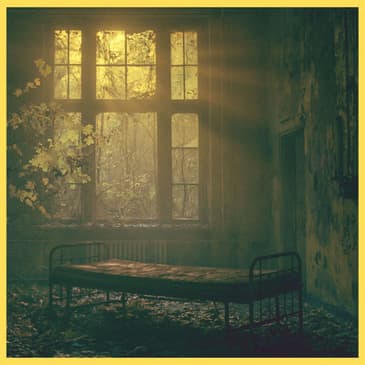
In this episode, we explore the infamous island of Poveglia, a place long associated with plague victims, abandoned hospitals, ghost stories, and one of Italy's most enduring paranormal legends. We separate historical fact from centuries of folklore while uncovering the truth behind claims of mass deaths, haunted bell towers, and mysterious sightings.
Then we travel to San Servolo, the forgotten "Island of the Mad," where more than 200,000 psychiatric patients passed through an isolated asylum. From medieval quarantine stations to World War II atrocities, these forgotten islands reveal how Venice once hid disease, suffering, and society's outcasts just beyond its famous skyline.
Are these islands truly haunted, or is history itself terrifying enough?
Find Edwin as @edwincov
For more of our shows, visit ScaryFM.com
HorrorStory.com
Around the time the Western Roman Empire was falling apart. Everyty people were terrified of invading barbarians, so to escape the violent attacks on the mainland, families fled into the lagoon and settled on Pavelia. Because the island was so small, the tight knit community could easily defend it from all sides. It served as a peaceful refuge for hundreds of years, but all that went away when in thirteen seventy nine a military fleet from Genua attacked the island during a war. The residents were forced to flee and relocate to a nearby island called Judeca, leaving Pavelia mostly abandoned and sitting quietly in the shadows. Fast forward to the Middle Ages, and Venice had grown into a massive, bustling center for trade. Ships were sailing in from all over the world, but it brought a total nightmare with them. The Pabonic plague, also known as the Black Death as you may have learned it in school. The sickness was devastating, killing at least one in three Venetians in a terrible way. Desperate to stop the spread and save their city, Venetian authorities created some of the world's first strict quarantine islands, which it called Lazaretti, to isolate the sick and clean the cargo off in coming ships. As a plague continued to return in waves. The story goes that the original quarantine islands fell into terrible condition and became too crowded, so Pavelia was dragged into the Nightmare as a massive dumping ground for the infected. If the person showed even a minor sign of the sickness, they were forced onto a boat and shipped to Pavelia, knowing that they would probably never see their families again. Local lore claims that is staggering one hundred thousand to one hundred and sixty thousand men, women and children were ultimately sent to the island, left to die, But the legends get even darker, stating that's dead and even those who were just too sick to protest were tossed and the giant bonfires at the center of the island. Today, local fishermen are still terrified to go near the shores because they believe that the island's dirt is heavily mixed with the human ashes. Same ashes from these mass burnings. Now, as someone who is fascinated by the paranormal. An island built on the ashes of one hundred and sixty thousand tortured souls is a perfect recipe for an extreme haunting. But even though the myths insist of hundreds of thousands dying in agony in the dirt, the actual historical record still a completely different story. This is where Pavelia's incredibly dark legend really begins, a place to die with death on its very soil. But that's not all we'll talk about today, because there's more islands shrouded in darkness, some of them you might have never heard of. My name is Edwin, and here's a horror story. In the late seventeen hundreds, Pavelia officially became a quarantine station known as the Lasaretto Novissimo. By this point in history, the plague was already dying down in Europe. Now, when you look at the official records from its time as a quarantine station, they state that only eighteen people actually died of the plague on Pavilia, so leaves us with the question did over one hundred thousand people really burn to ash on this tiny plot of land or its centuries of human fear and panic simply made up the ultimate ghost story out of just eighteen deaths. By the twentieth century, the island found a new, equally disturbing purpose. Nineteen twenty two, authorities decided to build a psychiatric hospital on Pavelia. Now remember that during this era, mental health was poorly understood, and the facility was largely used as a convenient place to hide the mentally ill away from the thriving, glamorous city of Venice. Because it was on an isolated island, the hospital had very little oversight, creating the perfect environment for absolute horror. According to the island's darkest legends, the chief doctor of the hospital became obsessed with brutal medical experiments. He allegedly performed crude lobotomies on his patients, claiming that he was searching for a medical cure for insanity. In reality, the story suggests that he simply had a sick desire to torture those in his care, hiding his cruelty under the guise of medicine. But if the stories are true, the patients on Pavilia weren't just suffering at the hands of this monstrous doctor. Many of the patients reported seeing mysterious figures wandering the hospital, hearing the terrifying voices of the plague victims, those who had died their centuries before, but because they were locked inside an asylum, nobody believed them, and their terror was simply written off as hallucinations and madness. Eventually, the doctor's horrific actions caught up with sometime in the nineteen thirties, a doctor himself began seeing the ghost of the patience he had tortured. Driven completely insane by the very spirits that he helped create, the doctor met a gruesome and he either threw himself or was pushed by unseen vengeful hands from the top of the island's tall brick bell tower. The legend gets even stranger. The most chilling part of the folklore claims that the fall didn't actually kill him. According to local stories, the doctor survived the impact of the long drop, only to be strangled to death by a strange srolling mist one that rose up from the island's cursed ground. Other variations of the legends say that his dead body was discovered dangling from the tower's bell rope. The hospital eventually closed and the physical bell was removed from the tower in the nineteen thirties, but even today, residents who live across a lagoon swear the dead of night they can still hear the phantom bell tolling from the empty island. With so much tragedy packed into one tiny space, it's not surprised that Pavelia has become famous for the specific spirit said to be trapped there. Today, if we talk to those brave enough to get close, you'll hear chilling stories about Little Maria, the ghost of a plague victim, who is often seen standing on the beach weeping out into the lagoon. Inside the running hospital, visitors claim to hear the terrifying sounds of Pietro, double amputee, whose phantom wheelchirk can still be heard furiously racing down the empty hallways. There's also the heartbreaking spirit of a young girl. She has a terrified look on her face, and it said that she's permanently trapped in time, still running and hiding from the cruel asylum doctor. The island's dark reputation has eventually on the attention of professional paranormal investigators, including the crew of Ghost Adventures. Actually, during one of their investigations, the host Zach Beggins claimed that he was physically scratched by an unseen force. Even more disturbing, the captured a piece of audio evidence and evp of a voice growling the words number eight. Many in the paranormal community believed that his voice was identifying itself as a mad doctor's eighth victim. But you don't even have to see a full body apparition to fall victim to Pavilia's darkness. Take the true story of a traveler who recently decided to test discourage by paying this local boat captain one hundred and thirty euros. He was to leave him on the island overnight when the sun was out. The abandoned ruins felt spooky but manageable. However, the moment the boat's motor faded away and true darkness fell, the terrifying reality of his situation set in arms. Without even a flashlight to guide him, he was completely trapped. He found himself paralyzed on the dock, too terrified to move as the agonizing silence and the creaks of the decaying buildings played tricks on his mind. He spent the next seven hours wide awake, staring into the dark, terrified that the dead were coming for him now. While he didn't end up coming face to face with the demon that night, he later confessed that the overwhelming sense of evil that seemed into his bones was enough to turn anyone into a believer. It just goes to show that on Pavilia, the psychological terror is just as real as a ghost. After the hospital officially closed its doors in the late nineteen sixties around nineteen sixty eight, with a complete evacuation in nineteen sixty nine due to a water supply issue, the island was simply left to rot. The Italian government didn't tear the structures down, that just walked away, leaving it vulnerable to thieves and vandals. Today, Paveglia is a chilling time capsule. Crumbling brick buildings, collapse roofs and rusted hospital beds still litter the grounds, slowly being swallowed up by thick vegetation as nature takes over the land. Because these remaining structures are incredibly unstable and dangerous, the government has officially closed the island tourism, but if you want to step foot on it legally, you need a special permit, which is notoriously difficult to get. The state has repeatedly tried to wash its hands of the island. In twenty fourteen, they even tried auctioning off a ninety nine year lease, hoping an ambitious investor would sweep in and redevelop the rotting ruins into I don't know, a luxury hotel or a high end resort. But no matter what they tried, the deals always seem to fall apart. Investors consistently back out, plagued by financial complications red tape, unable to shake off the island's disturbing, terrifying reputation. For a long time, it seemed like Pavelia was permanently cursed to remain an unsellable, abandoned wasteland. But recently the story has taken a really surprising and hopeful turn. A dedicated group of citizens form an association called Poveglia Pertuti, which translates to Pavelia for All. They're retired of seeing this historic peace of the Venetian Lagoon left to the ghosts and decay, so after fighting for over a decade, they recently won a massive victory, a six year concession from the state's property agency to take control of the northern part of the island. The dream isn't to build a dark tourism trap or a billionaire's playground. They want to clean up the decay and transform the island into a vibrant, public, urban lagoon park. They envision of green space where families and children can enjoy nature safely, blending the island's deep history back into the local community. It's a massive undertaking, but as they begin to clear the overgrowth, it leaves us with one fire lingering question. These citizens can successfully bring life, laughter, and nature back to Pavlia, will they finally wash away the centuries of pain and allow those restless spirits to find peace. While doing the research for this episode, I found that Venice had a bit of a dark side aside from the ghost stories and plagues, and that was that it would use its network of islands in the lagoon to hide away societies problems in the past, including people like lepers, amputees, and the mentally ill. So up next, we'll visit another location that formed a part of this group of islands that was used for disease and exile. It was easy to isolate people on these remote islands if the government didn't want them as part of regular society. One of the most famous of these locations is sanset volu An Islands, situated just a short boat ride south of the main city. To day, it is widely known by the nickname the Island of the Mad, but it wasn't always like that. For hundreds of years, going all the way back to the ninth century, Sanservolo was a quiet, peaceful Benedictine monastery and later a convent for nuns. In the early eighteenth century, only a few nuns were left, so the government stepped in and repurposed the island into a military hospital. Finally, in seventeen twenty five, the island was converted once again, this time into an official insane asylum. Originally opening its door just for men, the facility eventually took on women as well. Over the years, more than two hundred thousand patients passed through the asylum before it was finally shut down nineteen seventy eight. The atmosphere of the island has always left a heavy, lingering impression on those who visit. Even the famous poets Percy Bis Shelley, who once took a trip to the asylum with Lord Byron, felt its dark energy In his poetry, Percy perfectly captured the mood of the grounds, describing San Cervolo as a windowless, deformed and dreary pile. It's a place that still carries an intense emotional impact today, making it deeply fascinating for anyone interested in the supernatural, with the shadows of history. Adding to the eerie mystique of these Venetian asylum islands is what was left behind after the heavy door's close. If you explore the wild, overgrown grounds of the old asylums today, you'll find echoing, empty stone buildings. It will likely be watched by packs of feral cats. For example, on the nearby asylum island of San Clemente, which specifically housed female patients before becoming a luxury hotel, tall wired enclosures were left to hold dozens of prowling cats, fed and cared for by the devoted local women. These animals wandering around the old ruins give the whole area a restless, watchful energy. Walking through the grounds, it feels as if these creatures act as modern day guardians, silently keeping watch over the memories of the hundreds of thousands of forgotten souls who suffer there. When we look at the people who were sent to San Cervolo, becomes clear that it was a dumping ground for the doomed. Many of the patients sent to the island weren't actually suffering from natural mental illness, but from a horrific physical condition called pelagra. Back in the nineteenth century, this disease swept through northern Italy due to a poor diet that relied almost entirely on corn, which lacked a crucial vitamin. The locals called it rough skin. In its late stages, Pelagora caused severe dementia and violent insanity, which is exactly why so many victims were locked away on the island. One of the most chilling cases of this pelagor induced madness is a story of a poor shoemaker named Matio Luvat in eighteen o five. The disease completely messed up his mind, convincing him that he was a second coming of Christ. In a horrific dramatic display in Venice, he castrated himself and actually attempted to crucify himself. After this gruesome incident, he was sent to Sansevolo, where he refused to eat and ultimately starved himself to death. His tragic story is one of the first documented cases of this specific type of insanity, and it perfectly captures the extreme tortuous delusions these patients endured. The asylum was also a highly convenient tool for making people disappear. The notorious dictator Benito Mussolini famously used the Italian asylum system to lock away his first wife, Ida Dulcer, simply so he could silence her and marry another woman. Political opponents and dissidents who spoke out against the fascist regime were also frequently branded as socially dangerous and thrown into mental hospitals against her will. However, the darkest and most tragic chapter in the island's history early came during World War II. The conditions inside the asylum deteriorated into an absolute nightmare. Patients were trapped in freezing, unheated buildings with ballion, food, water, or medicine. Because of this severe deprivation, the death rate inside of these psychiatric hospitals skyrocketed to sixty times higher than that of the general population. To make matters even worse, the island offered no sanctuary from the wars atrocities The Nazis actually entered the Venetian asylums, dragging Jewish patients out of the facility and deporting them to concentration camps like Auschwitz, where almost all of them died. Now, when you consider the sheer volume of pain, starvation, and betrayal that happened within those stone walls, it's easy to understand why paranormal investigators and history buffs are so drawn to Sunset Volo. It's hard to imagine that such a profound, concentrated human suffering wouldn't leave a permanent, heavy psychic imprint behind. You can actually visit the museum at Sanset Volo today. There you're immediately confronted with exactly how these doomed patients were treated. The entire asylum system was built around social exclusion, physical segregation, and total isolation. Once you were sent to the island, you were entirely cut off from the rest of the world. As you walk through the exhibits, the tools that they used to restrain the people leave absolutely nothing to the imagination. The museum displays heavy iron chains, handcuffs, banicles, ankle locks, and straight jackets that were used to blind the mentally ill during the nineteenth century. There are even horrific devices on display that were specifically used for for speeding. Standing in front of these artifacts, you can easily picture the terrifying reality of what it was like to be trapped there completely powerless. But the physical restraints were just the beginning. These therapies that they used back then were straight up torture. One of the most striking objects you will see in the museum is an intimidating historic shower cage. This cage was used for a treatment called hydrotherapy, where patients were locked inside and subjected to either sudden freezing cold baths or scalding hot ones for prolonged periods of time. Then there is the equipment that is perhaps the most unnerving of all, the primitive electro shock machines introduced for so called therapeutic purposes in Italy during the nineteen thirties. These early machines were used to send electrical currents directly into the brains of the most vulnerable patients. Some visitors actually find these crude machines to be the eeriest items on the entire island. The amount of fear, pain and confusion experienced by these patients strapped into these devices is hard to imagine for anyone interested in the supernatural. These are exactly the kinds of objects that are believed to hold onto residual energy. It's hard to shake the feeling that the past is still present. You look out over the dark waters of the Venetian Lagoon, backed over the romantic, bustling canals of Venice, you realize just how perfectly this island served its purpose. The lagoon was a liquid wall designed to keep societies unwanted out of sight and out of mind. For two hundred thousand patients passed through Sansebolo, Many trapped into their own minds by diseases and were tortured. So the next time you picture the beauty of Venice, remember the forgotten islands of the Lagoon, places like Sansetbolo and Pavlia. Remember the feral cats standing guard in the overgrown gardens, and the echoing stone walls that absorbed the sadness, the screams, and the forgotten lives of the doomed. Venice is not the only place that hit its people that it didn't want, or the ones that were a threat to society. There's examples of it over and over in history, but I couldn't help at thinking about the pandemic and how we had to adapt quickly, and what if we happened to have a set of islands nearby or what had happened. Just wanted to leave you with that. As always, if you're subscribed, we'll be back next week with more. A huge shout out to our Scary plus members. That's wouldn't be possible without you. Thank you very much for listening. Keep it scary everyone. Let see as soon