
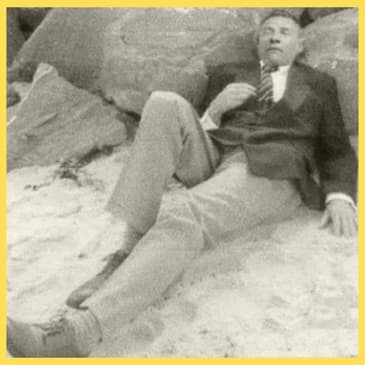
Despite the many efforts of detectives, scientists, and the public, the man could not be identified. What made this mystery bizarre, was that there were cryptic messages and clues that made no sense. A small rolled up piece of paper, no labels on his clothing, and no apparent signs of struggle. However, in 2022, science finally caught up with the case and the identity was revealed. But even with that information, the case still remains a mystery.
You can find Edwin social media as @edwincov
Have an idea you want to send? Send me an email or DM! hello@horrorstory.com
You can get these ad-free through ScaryPlus.com free for 14 days, then 4.99 per month. Cancel anytime.
Get in touch on HorrorStory.com
It is a last night of spring in South Australia. It's a Tuesday, November thirtieth, nineteen forty eight. The air is unusually warm, heavy with humidity, and a few buzzing clouds of mosquitoes are nearby. At around seven pm, a local jeweler named John Lyons and his wife are taking the regular evening walk along the shoreline of Somerton Beach, and just as they passed the prominent Somerton Crippled Children's Home, they look down at the sand and that's where they spot something strange. A well dressed man is slumped against a concrete sea wall. He's lying at the edge of the high water mark, right next to the wooden steps leading down to the beach. His legs are outstretched, his feets are crossed and pointing toward the dark and the coming tide. The Lion says, his pose looks kind of normal, actually almost as if he's just a drunk sleeping it off. I imagine it kind of right at the edge where you think, should we do something, or maybe we should let someone know right there. But John Lyons even made a joke to his wife. He was saying that maybe he should probably report it to the police, but then the slumped figure moved and as a watch the man fully extends his right arms straight up into the air. It hovers there in the dimming light for a silent second, then it falls slimply back down to his side. The lions assumes that the drunk is just trying and failing to light a cigarette. He checks his watch, notes the time, and the couple walks away into the twilight, leaving the man alone in the sand. Half an hour later, at seven pm, another young couple, Olive Neil and her boyfriend Gordon Straps they arrive on a motorcycle. They were looking to catch a cool sea breeze, so they sit on the wooden bench just south of the children's home. Directly below them, about nine meters down, lights the same slumped man. Olive looks down at him and a cold, inexplicable feeling washes over her. The seawall blocks her view of his upper body, but she can see his legs are still crossed. She turns to her boyfriend and whispers, perhaps he's dead. Gordon takes his glance over to it, and he tells her that she's being paranoid. The guy is clearly just fast asleep. He jokes about the thick, annoying swarm of mosquitoes buzzing around them, saying, as there are mosquitoes here, she must be dead to the world not to notice them. But as a couple finally gets up to leave at eight pm, Gordon notices a subtle, unsettling shift in the dark. The man's legs are extended now his left leg has been drawn up slightly, scraping a tiny silent track into the sand. And then before they walk back to their motorcycle, Olive Spots and other figure standing silently at the top of the concrete steps, staring directly down at the slumped man. Is a stocky, older man in a navy suit and a gray hat. He doesn't move, he doesn't speak, He just stands there in the dark, watching the body for five minutes. Who was he? We will never know. The street lights flicker to life, casting this long, distorted shadow across the beach, and the witnesses disappear into the night. They left the beach in absolute silence. The next morning, Wednesday, December first, his first official day of summer there, and at six thirty five am, John Lyons returns to the Summerton Beach for his regular morning swim, and as he walks along the shoreline, his eyes drift back to the concrete sea wall near the steps. The well dressed man is still there. He hasn't moved a single inch. His head is slightly inclined to the right, and his left arm lies outstretched on the cold, damp sand. His right arm is doubled over palm up. Lions approaches taking a closer look man his icy, cold, stiff and unresponsive. Panic sets in and Lions rushes back to his white street home and dials a Brighton police station. By six forty five am, Constable John Moss is on the beach kneeling over the corpse. The body is already locked, stiff, with dark purplish post mortem blood pulling behind his neck and ears. But as Moss begins with examination, the scene begins to defy all logic. First, there's a half smoked cigarette resting on the right collar of the dead man's double breasted coat, held in a place against his cheek, Yet the coat is not burnt and his cheek is not blistered. Second, the soft sand surrounding the body is completely and eerily undisturbed. There are no signs of struggle, no thrashing, no footprints of a killer, just a quiet, neat death on an open, highly public beach. And third, the corpse is immaculately clean. This isn't a homeless man or a rough traveler. His fingernails and toenails are clean and meticulously trimmed. And then there are his shoes. He's wearing expensive brown lace up shoes and they're perfectly mirror polished. There is virtually no sand on them. They still carry this high, brilliant gloss, a gloss that would have been completely scoffed and ruined that this man actually walked through the streets and gotten down to the wind blown sandy beach that day. It's as though his feet never actually touched the sand while he was alive. So when Constable Moss begins to search the dead man's pockets, looking for a name, a wallet, to clue something, the mystery turns pitch black because he finds an unused railway ticket to Henley Beach, a used bus ticket from Adelaide to Somerton, a packet of juicy fruit chewing and two combs, and then an open packet of Army Club cigarettes. But when Moss lights open the cardboard cigarette box, he finds it repacked. See inside there are seven cigarettes of a completely different expensive brand. Concede us. There's no wallets, no cash, not a single copper coin. There's absolutely no idea. The final almost chilling discovery comes when the police examined his high quality clothing. Every single label, every maker's mark, every laundry tag, and every name brand has been carefully systematically cut or torn out of his clothes. His identity has been surgically removed. The man slumped against a sea wall as a ghost, a ghost with perfectly polished shoes, a pocket full of mismatched cigarettes, and a face that looks like he died in his sleep, all walking caring a burning, invisible poison inside his chest. This is a mystery of the Somerton Man, the unknown dead man on the beach. My name is Edwin, and here's a horror story. After the dead man was carried off the sand of Somerton Beach, the police found themselves staring at this riddle that seemed designed to make them feel like they were chasing a ghost. You see, the police were left with a man of excellent physical health and athletic build and absolutely no history. And for weeks detectives and Adelaide checked every missing person's report in the country, nobody for the description. They sent his fingerprints to the FBI, to Scotland, Yard, to the agencies across the globe. The databases came back entirely blank. He didn't exist in any official records. Then, on January fourteenth, nineteen forty nine, Detective Sergeant Lionel Lean decided to shift his focus. He figured that if this man had traveled to Adelaide from somewhere else, he couldn't have just arrived on the beach with nothing but the clothes on his back in a pocket full of loose change. He had to have left a tray somewhere in the city. The detective went to the grand neoclassical Adelaide railway station and he started digging through the dusty shelves of the unclaimed baggage, and there, sitting in the dark, was a brown suitcase. The cloak room registers showed that the suitcase had been checked in on November thirtieth, nineteen forty eight, the very morning before the body was found, between eleven am and noon under the ticket number G five two seven zero three. The clerk on duty that day a porter named Ralph Craig. He couldn't remember the man's face obviously, had just been another busy morning, But when the detective opened the suitcase, he knew instantly that he had found this man. First found a card of highly unusual coarse sown thread. It was a distinctive warm sapia orange colored thread. Under a microscope, the detective matched that exact thread to the masculine rugged mending on the dead man's pants, the pockets, and the stitching where his coat collar had begun to give way. The suitcase belonged to the summertin man, but as it began to unpack it, the dread returned, just as the clothes on the body. Almost all of them inside the suitcase had their tags and laundry marks surgically sliced out. It was done in the exact same manner. Now there were a few slip ups, perhaps a set of deliberate decoys written in waterproof Indian ink on three of the items, a tie, a singlet, and a laundry bag. There were the names Keen or Keen with a E at the end, and t Keen. The detectives thought that this was a breakthrough that they had been praying for, so they launched this massive nationwide manhunt for any t Keen or Keen without the E who had gone missing in Australia. It checks military rosters, merchant navy records, post offices, and electoral roles. They found a few men with that name, but every single one of them was located, alive and well completely ruled out. The name was a dead end. It was as if the labels had been left there specifically to send the police on a wild goose chase, knowing that the dead man's real name was not Keen at all. But it was the other items in the suitcase that made the hair on the back of the detective's necks stand up. Among the tidy, well kept clothes, they found the strange kit of tools. There was a stenciling brush that had been used with some mysterious black substance. There was an electrician screwdriver, and then there was a common table knife that had been ground down and sharpened into the short, wicked, dagger like point. Alongside it was a pair of scissors, the blades aggressively reduced to just two inches and sharpened to a lethal crop. So why would this well dressed man carry a custom made dagger and a stenciling brush. Shipping experts suggested that it was a kind of gear a sailor might use to mark cargo on ships, but to the police it felt like the toolkit of someone who lived a double life. The final clue in the case was a pair of Elastra strap trousers. When the police turned them inside out, they found three sets of dry cleaning numbers written pencil on the pocket lining eleven seventy one slash seven forty three, ninety three slash three and three zero five to three slash one. The investigators photographed these numbers and sent them to every single dry cleaning firm across Australia that were pleading for a match. None of them recognize the markings, though experts later looked at the layout of the numbers and suggested that they had an English origin, potentially linked to drag cleaners in the United Kingdom. Now think about this picture, right, It's really strange. A mysterious, highly athletic stranger arrives in Adelaide by train. He checks his suitcase, keeping his polished shoes pristine. He has traveled from somewhere far away, maybe the UK or the United States, and he has systematically sliced his identity out of every collar, every pocket, in every scene. And then he walks down this public beach and he dies, and he's carrying nothing but a pocket full of expensive cigarettes repacked into a cheap box, which, by the way, is the other way that people would do this. Normally, they would have cheap cigarettes packed in this expensive looking box. So nothing made sense. He had swept his footsteps so perfectly that he was a nobody. Literally, no one knew who he was. But just when the police thought that, they added an absolute dead end. A University of Adelaide mythology professor named Joe Cleland was examining the dead man's pants. He slid his fingers inside a tiny heart to find fob pocket near the waistband, and there, rolled up into this really tight, really tiny cylinder was a piece of paper that would send the entire world into a spiral of spy theories, coded messages, and a strange attachment. When the professor unrolls this piece of paper in that cylinder that was in the clothing, he finds these printed Persian words tomm shoot. In English, it translates to a Chili phrase the end or the finish. Now these words are the final lines of the Rubaiyat of Omar Kayam, a collection of ancient poems about facing death without regrets. It wasn't just a random scrap, had actually been torn right out of a book. But where was the rest of that book? The police searched the entire country, I'm saying, they begged the public for any leads. They went everywhere, until finally this local businessman comes forward. He remember sparking his car near the beach, left and unlocked, and finds a cheap pocket edition of the Rubayat tossed onto the back seat. The detectives open the book, they see a jagged empty space where the final page has been torn out. The scrap from the dead man's pocket fits the tear perfectly. But it's the back cover of the book that truly makes a chest tighten here because scrawled in the faint pencil are five lines of capital letters, uncrackable chaotic code that would baffle the military's best cryptographers. And right beneath those mysterious letters is a phone number. The detectives trace the numbers straight to a young nurse living in Gleneld, near the very spot where the dead man was found on the sand. She's a woman the police will come to know only by her mysterious nickname Justin j E. S t y N. When the detectives bring Justin in for questioning, they show her the plaster cast of the dead man's face. It's a lifeless, stark white bust, capturing the stranger's features in a perfect, unblinking plaster. But the moment Justin looks at that cold white face, the color completely drains from her skin. She has taken aback to the point of looking as though she is about to faint, and yet she denies knowing him, insisting that she cannot identify the face. Instead, she offers a name. She tells the detectives that during the war she gave a copy of the Rubay yacht to an army lieutenant called Alfred Buxhall. She suggests that maybe this dead man is Buxaw. The detectives think that they finally have broken the case, and they rushed to Sydney to find him. But when they arrive, they find Alfred Bauxall alive and well, working quietly at the Randwick bus depot, and to grouve his identity. Buxhall takes the police to his home and pulls down his copy of The Rubaiyat, and he opens it to the final page. The detective see a chilling sight. The book is completely intact, not a single page has been torn. The book with the uncrackable code, and the nurse's phone number did not belong to him, belonged to a nameless stranger who carried her number to his grave, a man whose face terrified her to her core, but whose identity she took with her into the dark. She never ever admitted knowing the man. So truly understand how unsettling this mystery is. We ought to leave the open air of Summer Beach behind, and we have to go to a place that feels like it was built for things like these kinds of secrets. At seven thirty am on Thursday December second, nineteen forty eight, a young police constable named Sutherland walks into the Adelaide City Mortuary. Now the morgue sits in the southwest corner of the city, tuck deep inside the sprawling historic West Terrace cemetery. It is a bleak clinical room that smells heavily of formaldehyde, harsh, foul smelling soap that the attendants used to scrub their hands in a sense that's so thick and clinging that the officers dread it because it lingers on their skin and kind of ruins their appetite for days, or so, they say. Now, lying on the stainless steel table right in front of doctor Matthew Dwyer is a body of the unknown man. On the surface, he looks almost pristine. He is clean shaven, his fingernails are neatly trimmed, and his body is that of a powerful, highly fit athlete. But as doctor Dwyer begins in his autopsy, he's immediately confronted by a series of physical anomalies that defy the natural order of death. The first is a rigor mortis this incredibly intensely rigid body. The second is a strange purplish discoloration known as post mortem lividity. When a person dies, gravity pulls are blood down at the lowest points of their body, and the Somerton man was found sitting upright, propped against the concrete sea wall. His blood should have been pulled into his lower legs and hips. Instead, doctor Dwyer finds deep, dark lividity concentrated heavily behind his neck and ears and above his shoulders. Now it is a silent physical contradiction suggests that when this man drew his last breath, he wasn't sitting up on a beach. He was lying flat on his back. And then Dwyer looks at the man's face. A faint, dry trail of saliva has run out of the right side of his mouth, traveling diagonally down his cheek. Doctor Dwyer realizes that this saliva must have been dribbled out while the man was still alive, completely unconscious. His head was hanging limply to the side, and his body unable to perform even the basic reflex of swallowing. The man's pupils are small, uneven, and tightly contracted, and then doctor Dryer makes his first incision. Inside the Srton's man's body is a scene of quiet internal devastation. His pharynx is deeply congested, and doctor Dwyer examines the gullet the esophagus leading to the stomach. He finds a bizarre, creepy whitening of the tissue. It looks as though it has been bleached, and right in the middle of this palesophagus is a patch of raw open ulceration. Now doctor Dryer then opens the stomach and the horror just gets worse. The stomach lining is intensely, deeply congested, stained in a violent bright red, particularly in its upper half. It is covered in tiny, ruptured blood vessels. Inside mixed with the remains of cornish pasty the man had eaten roughly three to four hours before his death, is a significant amount of dark blood. Then Dwyer moved to the other organs. The kidneys are engorged, the lungs are dark and heavy with fluid. The liver is packed with a massive, abnormal excess of blood, and when Dwyer later places the slice of it under a microscope, he sees that the cellular centers of the liver lobules have been completely destroyed. Now the spleenness of swollen, congested monster is rock hard and three times its natural size. It's gorged to the bursting point with dark blood. And yet when doctor Dwyer reaches the heart, he finds it entirely normal, but is tough, firm and healthy. The heart of a man in peak physical training. There is one terrifying detail. The heart is completely contracted. He has stopped in a systel, which means clenched tight in a close fist, is totally empty of blood. Doctor Dryer here is convinced this is not a natural death. Something has burned this man from the inside out, causing his organs to drown in their own blood while his healthy heart clenched into a tight knot and refused to beat again. Doctor Dwyer carefully removes specimens of the man's blood, his urine, his liver and his stomach content. He seals them in glass jars and sends them to Robert Cohen, the deputy Government analyst and one of the most meticulous, highly respected chemists in Australia. And of course doctor Dwyer expects this quick, obvious answer. He expects co to find a massive dose of I don't know, barbiturates, cyanide, some common lethal poisons, but when the toxicology report comes back, they are entirely chillingly blank. Cohen has tested for everything cyanides, heavy metals, common alkaloids, carbolic acids, but nothing He runs the test again and again, and the results are pristine. There is absolutely no trace of any common poison in the man's system. How is it possible for a man's internal organs to be torn apart and congested with blood while his body remains a chemical ghost town. The mystery is so profound that the police bring in a giant of science, professor Sir Cedric Stanton Hicks, a world renowned authority on human physiology and pharmacology. He looks at the autopsy findings, the empty, clenched heart, the blood gorge liver, and spleen hemorrhaging stomach, and he realizes it's that they are looking at the work of a highly sophisticated, invisible killer. He suggests a group of extremely rare organic poisons known as cardiac glycosides. He writes two names down on a slip of paper for the corner, digitoxin and strophanthin. Strophanthin is a particularly terrifying substance. It's rare and it's deadly, I guess, derived from the seeds of the African strophantis plant, traditionally used by tribes to cope poison arrows. He explains that the terrifying physiology of how these glycosides kill. Turns out that if ingested, the act directly on the heart muscle, they force the heart to contract with agonizing violent strength, but they prevent it from relaxing, and with every single beat, the chambers of the heart fill with less and less blood. Not because the heart can't relax to receive blood, a massive invisible logjam occurs on the input side the body. The blood backs up, flooding backward into the liver, the spleen, and the lungs and gorging them until they are on the verge of rupturing. Eventually, the heart beats itself to death, clenching into a final empty spasm from which it could never release. And the most unsettling part. In nineteen forty eight, these organic glycosides left absolutely no chemical footprint. They were entirely undetectable by the standard laboratory tests. A killer could administer a tiny lethal dose and it would vanish from the tissues, leaving a perfectly healthy, clenched heart and a room full of baffled pathologist. But picks this guy, the world renowned physiologist and pharmacology guy. He was like, hold on, there's two gaping holes in this theory. First, cardiac glycosides caused violent, uncontrollable vomiting, and yet there was no vomits on the Somerton man, none in his clothes, and none in the clean sand where he lay. Second, if he had swallowed a massive dose of poison on the beach, he would have been in agony and convulsions, and all that people would have noticed if the sand around him was completely undisturbed, his clothes perfectly neat, his face entirely serene, as if he had simply drifted off to sleep. And then Sir Stanton Hicks utters a single sentence that turns the entire cold case into a nightmare. He notes that his entire physiological timeline is based on the assumption, but the man died on the beach. But then he adds, if it had not been self administered, and the body was brought there, that would remove any doubts, as well as any other difficulties. Now think about this, right, Think about what he's suggesting. If the summer to man was poisoned somewhere else, he would have suffered his violent chest heaving convulsions, bying all this stuff in this secret room flat on his back, which would perfectly explain why the blood pulled behind his necks and ears. Once he was dead, his killers would have thoroughly washed his body, dressed him in clean label its clothes, meticulously polished his shoes, and driven him to the beach in the dead of night. They would have carried him down the steps, propped them gently against the sea while crossing his legs, and placing a half smoked cigarette on his collar to make him look like a sleeping drunk. They created this perfect public stage. But as doctor Dwyer stands in the cold, chemical scented air of the West Terrace Morgue, he knows one thing for certain, whether this man walked to his death or was carried there as a corpse. He took the secret of whatever causes death with him for eleven years. The Somerton Man laid the dry earth of the West Terrace Cemitary under the headstone that simply read, here lies the unknown Man. It's actually the name of a book that I based a lot of this research on. It's a book by G. M. Feltis, if you want to look it up anyway. The case files gathered dust, the leads dried up, and the world moved on with the cold paranoia of the nuclear age. But on December fifth, nineteen fifty nine, a retired detective named Don Odherty walked to the Adelaide CIB with the report that would completely shatter the police's timeline of that faithful night in nineteen forty eight, a local businessman had finally summoned the courage to speak. He told Odoherty that on Tuesday, November thirtieth, nineteen forty eight, at around ten pm, he was down on Somerton Beach with a friend and two young sisters. The night was pitch dark, but as they walked north toward the Glen olg near the stretch of the sand dunes, they saw a bizarre, unsettling site. A well dressed man was walking along the water's edge and he was carrying another man draped over his shoulders. He was walking south, stepping directly on the wet sand because the incoming tide made it hard and easy to walk on. The witness assumed that the man on his shoulders was just a drunk who couldn't walk on his own, so the group didn't intervene. But think about what this sighting means. If this was a summerton man being carried in the dark. It completely explains the anomalies that baffled the pathologist. It explains why his expensive leather shoes were spotless and mirror polished when he was found, devoid of the scuffs and wind blown sand you would expect from walking down a beach. He explained why his blood had pulled deeply behind his neck and ears, the physical reaction that only happens when a person dies flat on their back, not sitting upright against the sea wall. If the witness was right and died somewhere else in the city, his body was thoroughly washed, and his pristine corpse was carries down the wooden steps into the dead of night and posed gently against the stone wall. He was placed on display for the world to find and then for over seventy years, that's where the story ended. A ghost on the sand, an uncrackable code, and a name lost the time. But then science finally caught up with this mystery. In twenty twenty two, a team led by Professor Derrick Abbott from the University of Adelaide took a fresh look at the plastered death mask that had been cast the one of the man's face before his burial in nineteen forty nine, when the taxidermist Paul Lawson had pressed a wet plaster onto the dead man's skin, a few strands of mousey graying hair had beencome trapped and embedded into the mold. Using advanced genetic genealogy and modern DNA sequencing, the researchers bypassed their previous dead ends. They extracted a DNA profile from those ancient dry strands of hair, and they finally gave the ghost his name back. He was Karl Charles Webb, and he wasn't a Russian spy, a rogue British defense scientist, or a shadow operative from the Eastern Bloc. He was a forty one year old electrical engineer and instrument maker from Melbourne. He was a mousey haired, athletic man who loved poetry and betting on horses. But here is the final, most unsettling truth of the Somerton man. Knowing his name does not solve the mystery. It only makes the shadows a little bit longer. If he was just a quiet Melbourne engineer, why did he travel hundreds of miles to Adelaide with a custom made dagger and a cargo marking stenciling brush hidden in his suitcase. Why did he systematically cut the labels out of every single shirt coat, pair of pants that he owned? Why did he pack expensive cigarettes in a cheap box? And then there was the nurse Tessie you see in his belongings. They found a bunch of other things. Right he had her private, unlisted phone number scribbled on the back of his copy of the Rubayet. Why did he die less than a quarter mile from her front door? And why when the detective showed her Charles Webb's plaster death mask did she turned pale as a piece of paper, clutching the table as if she was about to faint, only to swear to her dying day as she had never seen him before in her life. Kinda suspicious. So Carl Charles Webb took his secrets down to the wet sand. We have his name, we have his face, and we have his DNA. But the dark sign in space between his quiet life in Melbourne and his cold, poisoned body on Somerton Beach remains completely unbroken. Yet the code it's still uncracked. Poison is still nameless, and the man who carried him on his shoulders through the dark, and that last night of spring has long since vanished into the Adelaide fog. To all of you who suggested this story, thank you so much. Actually, you know, obviously a lot of us have heard about this man, the unknown Man, but recent developments with the DNA really changed up the story. Plus there's a whole series of things in the belongings that are found that really pieced together that maybe this nurse had something to do with it. And I know I kind of threw that curveball at you right because I didn't want to, like just tell you right off the bat that this is what it was, that maybe it was a double life and he got in trouble because of it. But I'm very interested in your thoughts. If you also researched this and find i don't know, some other information that was not covered here, please let me know so we can update this. As always, you can find more about me and the other shows from Scary FM in the description of this episode. Thank you very much for listening. Keep it Scary everyone, See you soon.