
You can find Edwin social media as @edwincov
Have an idea you want to send? Send me an email or DM! edwin@scarystory.com
You can get these ad-free through ScaryPlus.com free for 14 days, then 4.99 per month. Cancel anytime.
Get in touch on HorrorStory.com
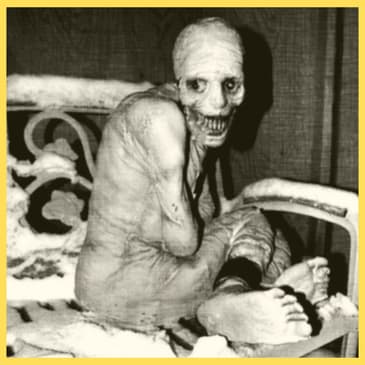
What if I told you that in the late nineteen forties, Soviet scientists locked five political prisoners in a sealed chamber for fifteen days and refused to let them sleep. That they pumped in a powerful stimulant gas designed to keep the subjects awake, indefinitely, monitoring their every word, every breath, and waiting for them to see what would happen to the mind when it was completely deprived of rest. Now this is the center of the story known as the Russian Sleep Experiment, and it's been shared across forums, blogs, YouTube narrations, reddit threads, even used as an inspiration for short films in indie horror games, and for over a decade it has remained one of the most iconic creepy pasta stories, a type of online urban legend crafted to disturb us. For a while, many readers thought it was real. The story was presented as a declassified document. It was clinical, detached, and written the tone of someone reporting facts instead of inventing fiction. Now it doesn't name its author. It uses just enough historical references like Cold War era Soviet science, secret experiments, military oversight. It just gave it a layer of the unsettling premise that this could be real and it feels like a leaf government file. The story first surfaced online in twenty ten on the Creepy Pasta wiki, posted by a user named Orange Soda. Like many creepy Pasta stories, it was anonymous, freely shared, and never intended to be a part of the public record, but it caught on right in the era where my interest in Internet stories was at its peak. In this episode, we're going to be exploring the full story of the Russian sleep experiment. After many email requests, comments, and dms. I'll tell you where it came from, how it spread, and what real science says about its claims. Also, what makes this particular horror story endure so long after its first telling. So let's begin and just the heads up, this episode is pretty graphic. It's fiction, but it's still pretty graphic, So if you're sensitive to that kind of thing, please take care of while listening to the story. My name is Edwin and here's a horror story. Russian researchers in the late nineteen forties kept five people awake for fifteen days using an experimental gas based stimulant. They were kept in a sealed environment to carefully monitor their oxygen intake. That way, the gas didn't kill them, since it was toxic in high concentrations. This was before close circuit cameras, so they had only microphones and five inch thick glass porthole sized windows into the chamber to monitor them. The chamber was stocked with books and cots to sleep on, but no bedding, as well as running water, a toilet, and enough dried food to last all five of them for over a month. The test subjects were political prisoners deemed enemies of the state during World War Two. Everything was fine for the first five days. The subjects hardly complained, having been promised falsely that they would be freed if they submitted to the test and did not sleep for thirty days. The conversations and activities were monitored, and it was noted that they continued to talk about increasingly traumatic incidents in their past. The general tone of their conversations took on a darker aspect after the four day mark. After five days, they started to complain about the circumstances and events that led them to where they were and started to demonstrate severe paranoia. They stopped talking to each other and began alternately whispering into the microphones and the one way mirrored portholes. Oddly, they all seemed to think that they would win the trust of the experimenters by turning over their comrades. The other subjects in activity with them. At first, the researchers suspected this was an effect of the gaes itself. After nine days, the first of them started screaming. He ran the length of the chamber, repeatedly yelling at the top of his lungs for three hours straight, at which point he continued attempting to scream, but was only able to produce occasional squeaks. The researchers postulated that he had physically torn his vocal cords. The most surprising thing about this behavior was how the other captives reacted to it, or rather didn't react to it. They continued whispering into the microphones until the second of the captives started to scream. The two non screaming captives took the books apart, smeared page after page with their own feces, and paged them calmly over the glass portholes. The screaming promptly stopped, so did the whispering into the microphones. After three more days pass the researchers checked the microphones hourly to make sure they were working, since they thought it impossible that no sound could be occurring with five people inside. The oxygen consumption in the chamber indicated that all five must still be alive. In fact, it was the amount of oxygen five people would continue to consume at a very heavy level of strain as exercise. On the morning of the fourteenth day, the researchers did something they said they would not do to get a reaction from the captives. They used to intercom inside the chamber, hoping to provoke any response from the people they were afraid were either dead or vegetables. The announced we were opening the chamber to test the microphones. Step away from the door and lie flat on the floor, or you will be shot. Compliance your immediate freedom. To their surprise, they heard a calm voice respond in a single phrase, we no longer want to be freedom. The bay broke out amongst the researchers and the military forces funding the research. Unable to provoke any more response using the intercom, it was finally decided to open the chamber at midnight of the fifteenth day, the chamber was flushed of the stimulant gas and filled with fresh air, and immediately voices from the microphones began to object. Three different voices began begging, as if pleading for life of loved ones, to turn the gas back on. The chamber was opened and the soldiers were sent in to retrieve the test subjects. They began to scream louder than ever, and so did the soldiers when they sobble was inside. Four of the five subjects were still alive, although no one could rightly call the state that any of them were in life. The food rations past day five had not been so much as touched. There were chunks of meat from the dead test subject's thighs and chest stuffed into the drain in the center of the chamber, blocking it and allowing four inches of water to accumulate on the floor. Precisely how much of the water on the floor was actually blood was never determined. All four surviving test subjects also had large portion of muscle and skin torn away from their bodies. The destruction of flesh and exposed bone on their fingertips indicated that the wounds were inflicted by hand, not with teeth, as the researchers initially thought. Closer examination of the position and angles of the wounds indicated that most, if not all, of them were self inflicted. The abdominal organs below the rib cage of all four test subjects had been removed, while the heart, lungs, and diaphragm remained in place. The skin and most of the muscles attached to the ribs had been ripped off, exposing the lungs through the rib cage. All the blood vessels and organs remained intact, but had been taken out and laid on the floor, fanning out around the inviscerated but still living bodies of the subjects. The digestive tract of all four could be seen to be working digesting food. It quickly became apparent that what they were digesting was their own flesh that they had ripped off and eaten over the course of days. Most of the soldiers were Russian special operatives at the facility, but still many refused to return to the chamber to remove the test subjects. Subjects themselves continued to screen to be left in the chamber and begged and demanded that the gas be turned back on lest they fall asleep. To everyone's surprise, the test subjects put up a fierce fight in the process of being removed from the chamber. One of the Russian soldiers died from having his throat ripped out, and another was gravely injured by having his testicles ripped off and an artery and his legs severed by one of the subject's teeth. Another five of the the soldiers lost their lives if you count the ones that committed suicide in the weeks following the incident. In the struggle, one of the four living subjects had a splened of ruptured and bled out almost immediately. The medical researchers attempted to sedate him, but this proved impossible. He was injected with more than ten times a human doze of a morphine derivative and still fought like a cornered animal, breaking the ribs and arms of one doctor. His heart was seen to beat for a full two minutes after he had bled out, to the point that there was more air in his vascular system than blood. Even after it stopped, he continued to scream and flail for another three minutes, struggling to attack anyone in reach, just repeating the word more over and over, weaker and weaker, until he finally fell silent. The surviving three subjects were heavily restrained and moved to a medical facility, the two with intec vocal cords continuously begging for the gas, demanding to be kept awake. The most injured of the three was taken to the only surgical operating room that the facility had. In the process of preparing the subject to have his organs placed back within his body, it was found that he was effectively immune to the sedative they had given him to prepare him for the surgery. He fought furiously against his restraints. When the anesthetic gas was brought out to put him under, he managed to tear most of the way through a four inch wide leather strap on one wrist, even though the weight of a two hundred pounds soldier was holding that wrist. It took only a little more anesthetic than normal to put him under, and the instant his eyelids fluttered and closed, his heart stopped. In the autopsy of the test subject that died on the operating table, it was found that his blood had tripled the normal level of oxygen. The muscles that were still at t attached to a skeleton, were badly torn, and he had broken nine bones in his struggle to not be subdued. Most of them were from the forest his own muscles had exerted on them. The second survivor had been the first of the group of five to start screaming. His vocal cords destroyed, he was unable to beg or object for surgery, and he only reacted by shaking his head violently in disapproval when the anesthetic gas was brought out near him. He shook his head yes when someone suggested reluctantly that they should try the surgery without anesthetic, and did not react for the entire six hour procedure of replacing his abdominal organs and attempting to cover them with what remained of his skin. The surgeon presiding stated repeatedly that it should not be medically possible for the patient to still be alive when terrified. Nerves assisting the surgery stated that she had seen the patient's mouth curl into a smile several times whenever his eyes met hers. When the surgery ended, the subject looked at the surgeon and began to wheeze loudly. Attempting to talk while struggling. Assuming this must be something of drastic importance, the surgeon had a pen and pad and fetched to the patients so he could write the message. It was simple keep cutting. The other two test subjects were given the same surgery, both without anesthetic as well, although they had to be injected with a paralytic for the duration of the operation. The surgeon found it impossible to perform the operation while the patients laughed continuously. Once paralyzed, the subjects could only follow the attending researchers with their eyes. The paralytic cleared their system in an abnormally short period of time, and they were soon trying to escape their bonds. The moment they could speak, they were again asking for the stimulant gas. The researchers tried, asking why they had injured themselves, why they had out their own guts, and why they wanted to be given the gas again. Only one response was given, I must remain awake. All three subjects restraints were reinforced and they were placed back into the chamber, awaiting determination as to what should be done with them. The researchers, facing the wrath of their military benefactors, for having failed the stated goals of the project, considered euthanizing the surviving subjects. The commanding officer and EXKGB instead saw potential and wanted to see what would happen if they were put back on the gas. The researchers strongly objected, but they were overruled. In preparation for being sealed in the chamber again, the subjects were connected to an EEG monitor and had the restraints padded for long term confinement. To everyone's surprise, all three stopped struggling the moment it was let slip that they were going back on the gas. It was obvious that at this point all three were putting up a great struggle to stay awake. One of the subjects that could speak was humming loudly and continuously. The mute subject was straining his legs against the leather bonds with all his might, first left, then right, then left again for something to focus on. The remaining subject was holding his head off his pillow and blinking rapidly. Having been the first to be wired to the EEG machine, most of the researchers were monitoring his brainwaves. In surprise, they were normal most of the time. But sometimes flatlined inexplicably. It looked as if he were repeatedly suffering brain death before returning to normal As to focus on paper scrolling out of the brainwave monitor, only one nurse saw the man's eyes slip shut at the same moment his head hit the pillow. His brain waves immediately changed that of deep sleep and then flat lined for the last time as his heart art simultaneously stopped. The only remaining subject that could speak started screaming to be sealed in. Now, his brain waves showed the same flat lines as the one who had just died from falling asleep. The commander gave the order to seal the chamber with both subjects inside, as well as three researchers. One of the name three immediately drew his gun and shot the commander point blank between the eyes, then turned the gun on the mute subject and blew his brains out as well. He pointed his gun at the remaining subject, still restrained to a bed, as the remaining members of the medical research team fled the room. I won't be locked in here with these things, not with you, he screamed that the man strapped at the table. What are you? He demanded, I must know. The subject smiled. Have you forgotten so easily? The subject asked? We are you. We are the madness that lurks within you, all begging to be free at every moment, in your deepest animal mind. We are what you hide from and your beds every night. We are what used to date into silence and paralysis when you go to the nocturnal haven where we cannot tread. The researcher paused, and then aimed at the subject's heart and fired. The EEG flat lined as a subject weekly choked out so rearly fur The earliest known version appeared on Creepy Pasta wiki in August of twenty ten, without any accompanying explanation or context. That lack of framing is what made it so effective. It read like a leaked report of a suppressed government file shared anonymously online. It was long by creepy Pasta stand far more detailed in structure than most, and didn't have supernatural monsters or haunted objects. Instead, it relied on something far more unsettling, the limits of the human body and the darker corners of the human mind. Not long after it was posted, the story began to spread. It showed up on reddits, no Sleep, YouTube narrations again, horror forums, tumbler posts, and then within a year had become one of the most widely shared creepy pastas on the Internet. Readers debated whether it could be real. Some swore it was based on a real experiment. Others claim to have seen the photo that proved it, and that photo, the distorted humanoid figure with the pale skin, bulging eyes, and twisted grin became permanently linked to the story. It was usually presented without explanation, and if you want to look for it, it's called spasm spazm dot PNG. That's what is usually labeled as it supposed to show one of the surviving test subjects. In reality, though the images of a Halloween prop. It's a magnequin design for a horror attraction, not an actual photograph of a medical experiment, But it served its purpose. It made the fiction feel like fat. This kind of digital myth making isn't unique to the Russian Sleep experiment. Stories like the slender Man, Jeff the Killer, and Ben Drowned all gained traction in similar ways. Anonymous postings, viral sharing, and just enough realism to make people question what they were reading now. What sets the Russian Sleep Experiment apart is how effectively it mimics official language. He uses all these medical terms, military structure, and psychological concepts with just enough plausibility it's going to draw readers in. It also avoids a clear narrative voice, just cold, procedural horror. It plays on our fear of what institutions are capable of when they operate in secrecy, and it echoes real world atrocities like Project mk Ultra, the CIA's mind controlled experiments, or the war crimes committed by Unit seven thirty one, a covert Japanese biological warfare unit during World War Two. It feels like it could be true. Let's step back from the horror for a moment and ask a simple question, what actually happened to the human body and mind when we don't sleep? In reality, the effects of sleep deprivation are well documented. Scientists have actually studied it for decades, and while no one has ever tried to keep people awake for thirty days under gas and military supervision, we do know what happens to the brain when it's deprived of rest or even a short amount of time. After just twenty four hours without sleep, most people experience reduced concentration, irritability, slower reaction times, and impair judgment. It becomes harder to pros as information or make decisions. You feel foggy, emotionally unstable, and drained. After forty eight to seventy two hours, the effects become more severe. People begin to experience micro sleeps, brief and voluntary lapses in consciousness that last just a few seconds. The brain is so desperate for rest that it shuts down small sections of itself while the rest of you remains awake. Now by the third day, hallucinations often begin. Some people report seeing shadows moving at the edge of their vision, hearing phantom sounds, or feeling like the surroundings are shifting. Mood swings become extreme, and logic breaks down. By the fourth or fifth day, the brain may start to lose its grip on reality entirely. Paranoia, delusions, and full blown psychosis can emerge. People begin to misinterpret events and perceive threats where none exist. They may become more aggressive, unpredictable, or to sociative in extreme cases. For long, sleep deprivation has been used as a form of torture. It disorients, destabilizes, and eventually breaks down the ability to resist. But even under those conditions, what happens is psychological collapse, not supernatural transformation. The longest scientifically documented period a person has voluntarily stayed awake these eleven days or two hundred and sixty four hours. That record belongs to Randy Gardner, a high school student who did it in nineteen sixty four as part of a science fair experiment. By the end, he was mentally and physically impaired, experiencing hallucinations, memory lapses, and slurred speech, but he made a full recovery after sleeping. There is no known case in medical history of someone remaining awake for fifteen or thirty days and surviving in any functional state. The body simply would not allow it. What about the stories more grotesque claims, right, like people ripping out their own organs or continuing to function after the heart has stopped, Well, those are just medically impossible. The story's portrayal of people immune to anesthesia or screaming minutes after death crosses the line into body horror, a deliberate exaggeration designed to disturb and not really inform sleep is one of the most essential, vulnerable parts of human life. We spend nearly a third of our lives unconscious, unguarded, and unaware. And the idea that's something anything could interfere with that cycle, and that could trap us in our own waking nightmare, it's terrifying. The story takes that fear and magnifies it. It shows us what might happen if the mind was stretched past that breaking point, and it says, this is what's hiding beneath the surface of your consciousness, just you without sleep, sanity, or limits. The Russian Sleep Experiment is just a horror story about an ethical time scientific trials gone terribly wrong. But beneath that gore and the gas, it's doing something more deliberate. It's exploring a set of psychological and philosophical fears that have haunted humanity long before the Internet gave them form. So here are two themes, right, Let's start with the central one, madness. What makes part of the story terrifying is the sense that people inside the chamber have lost their minds, and worse, they know it, and they don't fight to escape. They fight to stay awake, and when given the chance to be freed, They say, no, this is completely opposite to what we're used to. Normally, a victim wants to survive, to escape the threat, but here the threat becomes sleep itself, the one thing we all need to survive, So that reversal is very unsettling. Are that second major theme is control or the loss of it. The prisoners agree to the experiment because they've been promised freedom, but it's a false promise. Right from the beginning. They are being controlled by the researchers, the ask the confinement, and eventually by their own unraveling mind. Even the researchers lose control, they said the conditions they oversee the experiment, but as things are going wrong, they're powerless to stop it. Their protocols fail, and their moral boundaries collapse. By the end, they're just as complicit as a gas that broke the subjects down. I don't know about you, but the part about the last subject that is asked about what he is, and he says, we are you. We are the madness that lurks within you, all begging to be free at every moment in your deepest animal mind. It just brought me back to when I first heard it that feeling that something's off, not because it's completely different or impossible, but because it's almost normal, like a warped mirror of what we recognize. It's what we call the uncanny, and that it's in ourselves basically. In this story, what scared me the most was the way consciousness becomes its own enemy, and the way the human need to stay alive becomes a compulsion that destroys the now. That's the horror that is always capable inside of all of us, that mindset. It's the scariest part. Now, more than a decade after it first appeared online, the Russian Sleep Experiment is still one of the most well known creepy pastas in existence, and unlike many viral stories that burn out quickly, this one has stuck around. It continues to resurface the new forms, new platforms, shared by new generations of readers, who often encounter it with the same question is this real? Is it the first time you hear about it? Now? I like to think of the Russian Sleep Experiment as a modern myth, like the urban legends that came before it, stories of vanishing hitchhikers, cursed videotapes, shadowy government programs. It plays on anxieties we don't always talk about out loud. It asks what are the limits of the human mind? And what happens when we stop sleeping, stop dreaming, stop resting, and start unraveling. Is that inside of each of us is something darker, something desperate to emerge. Is it something that only silence, sedation, or sleep keeps buried? And that's why, no matter how many times we remind ourselves that it's just a story, we can't quite let it go, because deep down, part of us still wonders what if it isn't. This episode of horror Story was researched and written by me Edwin Kovarubias based on requests from our horror Story listeners. Now let me know what you thought about it by sending me a message through horror story dot com or in the contact information and the description of this episode. Also, thank you for your support for our previous episode, How Governments Disappear Humans. It was a very tough episode to come up with with you all the search and finding out about all these atrocities that are happening, and it became even worse once I started comparing all of the all of the patterns, but we'll leave it at that, and if you have comments of there's something you want to talk about, please email me Edwin at scarystory dot com. Anyway, thank you very much for listening and for your support. Keep it scary everyone, See you soon.